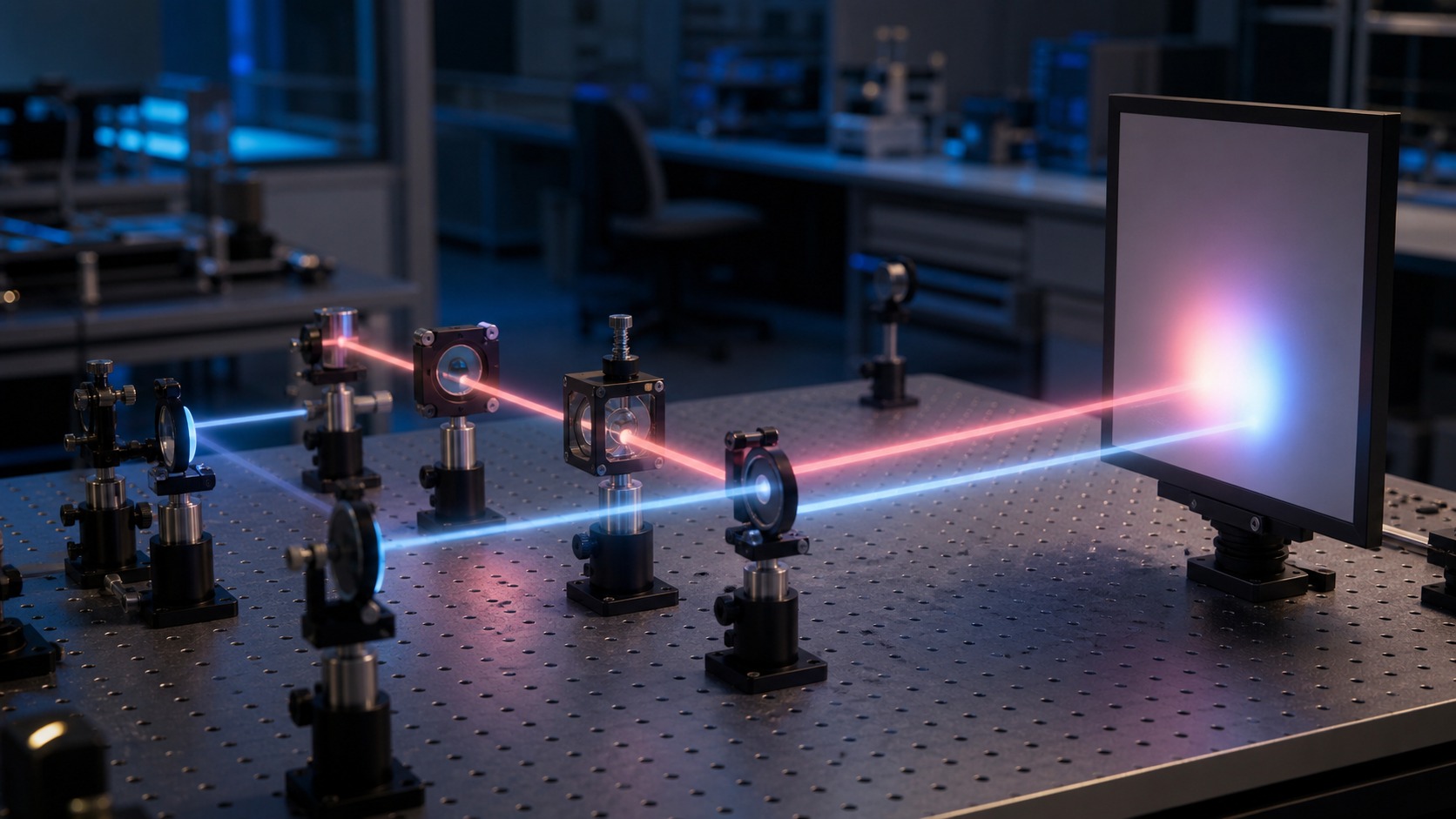
At first glance, the idea seems simple: you look at something, and you learn what it is doing. In everyday life, observation feels passive, almost harmless. You glance at a clock to see the time, or watch a car pass by without affecting its motion. In the quantum world, however, observation is not a neutral act. It is a physical interaction with profound consequences. When you observe a quantum state, you do not merely uncover reality—you help create it. This strange relationship between observer and observed sits at the heart of quantum mechanics and challenges our deepest assumptions about how the universe works. To understand what truly happens when a quantum state is observed, we must first let go of classical intuition and step into a world where probabilities, waves, and particles blur into something fundamentally new.
A: No, any physical interaction counts.
A: Yes, once a definite result is recorded.
A: Quantum theory says yes.
A: No, it’s irreversible.
A: Large systems interact too much with their environment.
A: No, only interactions matter.
A: The result appears immediate.
A: Only probabilities can be influenced.
A: It creates definite outcomes.
A: Yes, interpretations differ.
The Nature of a Quantum State
A quantum state is not a simple label like “here” or “there,” “on” or “off.” Instead, it is a mathematical description that captures all the possible outcomes a quantum system can produce when measured. Before observation, a quantum state encodes a range of possibilities rather than a single, definite reality.
Imagine an electron moving through space. In classical physics, it has a specific position and velocity at all times, whether you measure it or not. In quantum mechanics, the electron is described by a wavefunction, which spreads out and assigns probabilities to different positions and momenta. The electron is not at one exact point in space; it exists in a superposition of possibilities.
This does not mean the electron is “mysteriously everywhere” in a mystical sense. It means that, until an interaction forces a definite outcome, the theory only allows us to speak in terms of probabilities. The quantum state is a catalog of what could happen, not a statement of what already is.
Superposition: Many Possibilities at Once
Superposition is one of the most famous and misunderstood aspects of quantum mechanics. A quantum system can exist in multiple states simultaneously, at least according to its mathematical description. A particle can be in a superposition of positions, energies, or even different paths through space.
This idea becomes especially vivid in thought experiments like the famous cat scenario proposed by Erwin Schrödinger. The purpose of that paradox was not to suggest that cats are literally both alive and dead, but to highlight how strange quantum superposition appears when extended to the macroscopic world. At the microscopic level, superposition is not a metaphor—it is a precise and testable feature of nature.
Before observation, the quantum state does not pick a single outcome. Instead, it evolves smoothly according to mathematical rules, preserving all allowed possibilities at once. Observation changes that in a dramatic way.
Measurement: More Than Just Looking
In quantum mechanics, observation is not about human awareness or conscious attention. It is about physical interaction. A measurement occurs when a quantum system interacts with another system in such a way that information about a specific property becomes fixed and, in principle, accessible.
This interaction could involve a detector, a screen, a measuring device, or even the surrounding environment. The crucial point is that measuring a quantum state requires coupling it to something else, and that coupling alters the system.
When you measure a quantum property—such as position, spin, or energy—you force the system to give a definite answer. The range of possibilities encoded in the quantum state is reduced to a single outcome. This transition is abrupt and irreversible, and it is what makes quantum measurement fundamentally different from classical observation.
Wavefunction Collapse: From Possibility to Reality
The most widely known description of quantum observation involves wavefunction collapse. According to this view, the act of measurement causes the quantum state to collapse from a superposition of possibilities into one definite result.
Before observation, the wavefunction spreads across many potential outcomes. After observation, it snaps into a form consistent with what was measured. If you measure an electron’s position, you find it at one location, not spread out over space. If you measure its spin, you get one value, not both.
This idea was central to the Copenhagen interpretation, developed in part by Niels Bohr. In this framework, quantum mechanics does not describe an objective reality independent of measurement. Instead, it provides rules for predicting measurement outcomes. Reality, in this sense, becomes inseparable from observation.
While the notion of collapse is mathematically convenient and historically influential, it also raises deep questions. What exactly causes the collapse? Why does it happen at the moment of measurement and not before? These questions remain open and controversial.
The Role of Probability and Randomness
One of the most unsettling aspects of observing a quantum state is the role of true randomness. Quantum mechanics does not merely hide information from us; it asserts that certain outcomes are fundamentally unpredictable.
When you observe a quantum state, the specific result you obtain is not determined in advance, even if you know the quantum state perfectly. The theory can tell you the probability of each outcome, but not which one will occur in any individual measurement.
This randomness is not due to experimental limitations or hidden variables, at least according to standard quantum theory. It is an intrinsic feature of nature. Each observation is a moment where the universe selects one possibility from many, guided only by probability.
Over many repeated measurements, patterns emerge that match the predicted probabilities with astonishing accuracy. Yet each individual event remains irreducibly uncertain.
Entanglement and Observation at a Distance
Observation becomes even more intriguing when quantum states are entangled. Entangled particles share a single quantum state, even when separated by vast distances. Measuring one particle instantly determines the outcome of a corresponding measurement on the other, no matter how far apart they are.
This phenomenon deeply troubled Albert Einstein, who famously referred to it as “spooky action at a distance.” However unsettling it may seem, countless experiments have confirmed entanglement as a real feature of the world.
When you observe one part of an entangled system, the combined quantum state changes immediately. This does not allow for faster-than-light communication, but it does show that observation has nonlocal consequences. The act of measurement does not just affect the system you touch; it reshapes the shared quantum state as a whole.
Entanglement highlights how observation in quantum mechanics is not a private or isolated event. It is a global update to the structure of reality described by the quantum state.
Decoherence: The Environment as an Observer
Modern physics has refined our understanding of observation through the concept of decoherence. Decoherence explains how interactions with the environment can effectively destroy quantum superposition without invoking a mysterious collapse.
In practice, no quantum system is perfectly isolated. Even tiny interactions with surrounding particles, radiation, or fields can entangle a system with its environment. As this happens, the delicate phase relationships that define superposition become scrambled.
From the perspective of the system alone, superposition seems to vanish, leaving behind outcomes that behave classically. Decoherence explains why we do not observe quantum superpositions in everyday objects, even though quantum laws still govern their components.
Importantly, decoherence does not select a single outcome by itself. It explains why different outcomes stop interfering with one another, but not why one particular result is observed. Observation, in this view, is tied to how information becomes distributed and irreversible in the environment.
Consciousness and the Observer Question
One of the most persistent myths about quantum observation is that human consciousness plays a special role in collapsing the quantum state. While this idea has captured popular imagination, it is not supported by mainstream physics.
Quantum mechanics requires interaction, not awareness. A detector records a result whether or not a human looks at it. Data stored on a hard drive or imprinted on photographic film counts as a measurement long before anyone becomes conscious of it.
That said, the philosophical implications of observation are profound. Quantum mechanics forces us to confront the limits of objectivity and the relationship between knowledge and reality. But these issues belong to the philosophy of science, not to claims that the mind directly controls physical outcomes.
Different Interpretations of Observation
Physicists agree on the mathematical predictions of quantum mechanics, but they disagree on what those predictions mean. As a result, multiple interpretations exist, each offering a different answer to what happens when a quantum state is observed.
The Copenhagen interpretation emphasizes collapse and the central role of measurement. The many-worlds interpretation denies collapse altogether, suggesting that all possible outcomes occur in branching universes, with observation corresponding to the observer becoming entangled with one branch.
Other approaches, such as relational quantum mechanics and objective collapse theories, offer alternative ways to understand observation and outcome selection. None of these interpretations changes experimental results, but they deeply influence how we think about reality. Observation, in this sense, is not just a physical process but a conceptual crossroads where physics meets philosophy.
Experimental Evidence and Real-World Applications
Observation effects in quantum mechanics are not just theoretical curiosities. They have practical consequences that power modern technology. Devices such as quantum sensors, atomic clocks, and quantum computers all rely on precise control of measurement and observation.
In quantum computing, for example, observing a qubit at the wrong time destroys the computation by forcing a definite outcome too early. Engineers must carefully manage when and how measurement occurs to preserve superposition and entanglement until the desired moment.
Experiments have also shown that measurement can be tuned and controlled, blurring the line between observation and evolution. Weak measurements allow partial information to be extracted without fully collapsing the quantum state, revealing that observation is not always an all-or-nothing event.
Why Observation Changes Everything
At its core, observing a quantum state is an act that transforms possibility into fact. Before observation, the quantum state encodes what might happen. After observation, one outcome becomes real, recorded, and irreversible.
This transformation is not a flaw in our understanding; it is a feature of how nature operates at its most fundamental level. Quantum mechanics does not describe a static reality waiting to be revealed. It describes a dynamic interplay between systems and the interactions that define them.
Observation marks the boundary between the quantum world of probabilities and the classical world of experiences. It is the bridge that connects mathematical abstraction to tangible reality.
Living With a Quantum Universe
The idea that observation plays an active role in shaping outcomes can feel unsettling. It challenges the comforting notion that the universe exists in a fully defined state independent of us. Yet it also reveals a universe that is richer, more subtle, and more interactive than classical physics ever imagined. When you observe a quantum state, you participate in a fundamental process that has been unfolding since the birth of the universe. Every measurement is a moment where uncertainty resolves into fact, guided by laws that are precise, predictive, and profoundly strange In accepting this, we gain not only better technology and deeper scientific insight, but also a humbling perspective on our place in nature. The quantum world reminds us that knowledge is not just about discovering reality—it is about engaging with it.