From Probability Cloud to Definite Result
Quantum mechanics begins many experiments with uncertainty, but it does not end in confusion. A photon lands in one place. A spin measurement returns one result. A detector records a particular event that can be written down, compared, and used in later calculations.
The strange part is that the certainty appears only after a measurement has selected one outcome from a range of possibilities.
Before the measurement, the wavefunction gives probabilities. Afterward, the record says what actually happened in that run. Understanding how quantum measurements create certainty from uncertainty means seeing both sides at once: the theory’s honest embrace of probabilistic possibilities and the laboratory’s unmistakable production of definite facts.
This is why quantum physics can feel both unsettling and dependable.
It gives up the classical dream of perfect advance prediction for individual events, yet it gives laboratories exact rules for turning preparation, measurement, and repetition into trustworthy knowledge.
The certainty is earned in stages: first by preparing the system, then by asking a well-defined question, then by preserving the answer as a record that other observers can check.
That layered process is what lets a probabilistic theory become an exact experimental science. The outcome is not certainty replacing uncertainty like a light switch. It is certainty emerging from a controlled chain of physical steps. This distinction helps avoid two mistakes at once.
Quantum mechanics is not saying that everything is vague forever, and it is not saying that every result was simply waiting as a classical fact.
It says the preparation gives probabilities, the apparatus defines the question, and the measurement supplies the record. The beauty is that this record can be humble and final at the same time: humble because it answers one context-bound question, final because that answer is now part of the experimental history.
A single click may not reveal the whole wavefunction, but it does give one firm entry in the ledger of what happened.
Once many such entries are gathered under controlled conditions, the uncertain possibilities reveal a remarkably stable pattern. That pattern is the quiet source of quantum certainty: not a guarantee for the next event, but a dependable structure across the experiment as a whole.
The certainty lives in the disciplined relationship between preparation, question, record, and repetition. Without all four, the result would be much harder to trust.
A: The recorded answer to the specific question defined by the apparatus becomes certain for that trial.
A: Not in the standard view for many measurements; the wavefunction gives probabilities rather than a full set of prior facts.
A: The wavefunction evolves by precise rules, and the Born rule converts it into reliable long-run frequencies.
A: No. One measurement gives one result; repeated trials reveal the distribution.
A: Often yes, and a compatible immediate repeat may confirm the state prepared by the first result.
A: It defines which property or basis is being measured, so it changes the possible answers.
A: No. Quantum mechanics can give certainty about one measured outcome while leaving incompatible questions uncertain.
A: It helps make records stable and classical-looking, though interpretation debates continue over outcome selection.
A: They use calibration, controls, repetition, and noise analysis to confirm the signal is real.
A: Measurement turns a probability-weighted quantum possibility into a stable recorded fact.
Uncertainty Does Not Mean Disorder
Quantum uncertainty is often mistaken for total randomness. In reality, it is highly structured. The wavefunction does not say “anything might happen” in a loose way. It assigns precise probability amplitudes to possible outcomes, and those probabilities can be tested through repeated experiments.
If a system is prepared the same way many times, the distribution of results follows a stable pattern.
Think of uncertainty as a map of possibilities rather than a fog of ignorance. The map does not tell you which single result will appear next, but it tells you which results are allowed and how likely they are.
Quantum theory is powerful because those maps are mathematically exact even when individual outcomes remain unpredictable.
A good preparation procedure makes the map repeatable, so two laboratories can prepare the same kind of state and compare the patterns their detectors produce.
What a Measurement Adds
A measurement adds a physical event that can be treated as a record. Before measurement, the system may be described as a combination of alternatives. During measurement, the system interacts with an apparatus designed to distinguish those alternatives.
After measurement, the apparatus points to one result. That result becomes part of the experimental history.
This is why measurement has a special status in beginner explanations. It connects the quantum description to ordinary evidence. The wavefunction gives the recipe for probabilities, but the detector supplies the actual outcome in a particular run.
Without measurement, quantum theory would remain a calculation about possibilities. With measurement, it becomes a science of observed events.
The record also changes what can sensibly be predicted next. Once an apparatus has found a value, a repeated compatible measurement is no longer treated as a fresh roll of the same dice. The state used for future predictions is updated around the result that actually appeared.
The Born Rule and Reliable Odds
The Born rule is the bridge between the wavefunction and measurement probabilities. It tells physicists how to calculate the chance of each possible result. You do not need the equation to grasp the idea: the wavefunction contains weights, and those weights determine the long-run pattern of outcomes.
A result with a larger weight appears more often across repeated trials.
The certainty of any one measurement is therefore not the same as certainty in advance. Before the experiment, quantum mechanics may only give odds. After the detector records an event, the outcome for that trial is definite.
Over many trials, the odds themselves become visible as a pattern. Individual uncertainty and statistical certainty coexist.
This is one reason quantum mechanics can feel paradoxical: it denies perfect prediction for single events while delivering incredibly precise predictions for collections of events. The uncertainty is real, but it is not sloppy. It is disciplined by preparation, symmetry, conservation laws, and the exact measurement being performed.
Why the Apparatus Matters
A measurement is not just “checking what is there.” The apparatus defines the question being asked. A spin experiment oriented vertically asks a different question than one oriented horizontally. A position-sensitive detector asks something different from a momentum measurement.
The certainty produced by measurement is certainty about the outcome of a particular experimental arrangement.
This point protects us from a common mistake. We should not imagine that measurement reveals every property at once. It creates a definite answer within a chosen context.
After a position measurement, the particle has been localized for that purpose, but that does not mean all incompatible properties have also become sharply known.
Context is not a loophole or a human preference. It is built into the physical arrangement of magnets, lenses, detectors, filters, or circuits. Change the arrangement, and you may have changed the set of possible outcomes that quantum theory is being asked to predict.
Records Make Outcomes Shareable
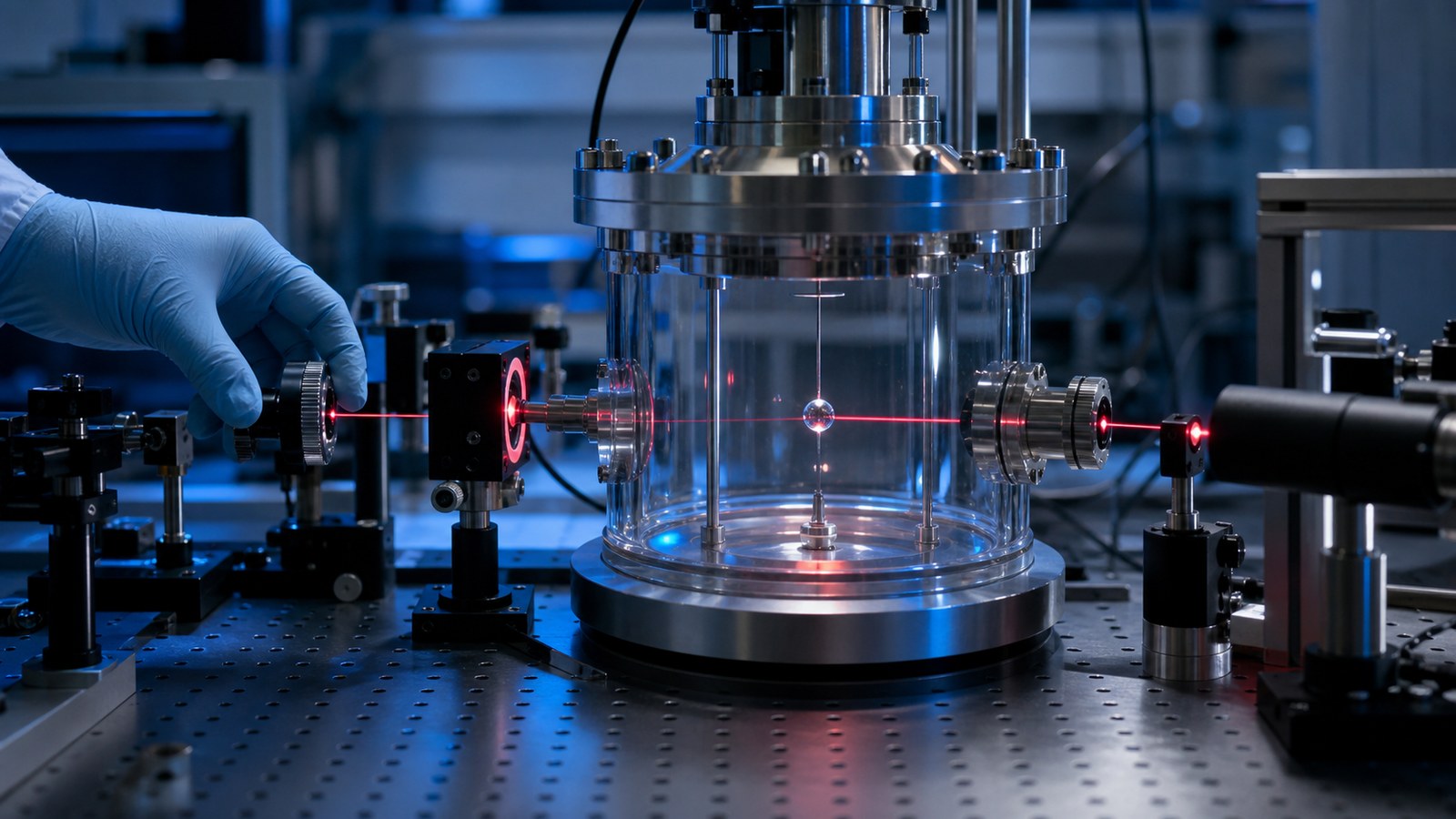
For an outcome to count as a measurement result, it must become stable enough to be shared. A microscopic interaction is amplified into something classical: a mark, a current, a click, a bright spot, a stored bit.
Once that record exists, different observers can agree on it. The result has entered the ordinary world of evidence.
Decoherence helps explain why these records behave classically. When the measuring device and environment become entangled with the outcome, delicate quantum interference between alternatives becomes practically unavailable. The system’s possibilities no longer overlap in a way that can easily recombine.
That is how a fragile quantum event becomes a robust fact for all practical purposes.
Still, decoherence does not erase every foundational question. It explains why the record is stable and why alternatives stop interfering, while debates continue over whether it also explains why one outcome is the one we experience.
In everyday laboratory work, though, decoherence is why a dot on a detector can be treated as a fact rather than as a delicate wave waiting to interfere again.
State Update After the Result
Once a result is known, physicists update the system’s state. This is not merely bookkeeping. If you immediately repeat the same measurement, you often get the same result, because the first measurement prepared the system in a state aligned with that outcome. Measurement can therefore both reveal and prepare.
For example, if a spin measurement gives “up” along a chosen axis, a repeated measurement along that same axis will return “up” with certainty, assuming nothing else disturbs the system. But a measurement along a different axis may again produce probabilistic results. Certainty is local to the context created by the measurement.
This is why measurement outcomes become useful building blocks. A result can reset the starting point for the next step in an experiment, allowing researchers to prepare selected states, verify devices, or feed information into a larger protocol.
Certainty is not only a philosophical endpoint; it is a practical resource. In quantum computing, a mid-circuit measurement can guide later operations.
In atomic physics, a confirmed state can be used as the launch point for a more delicate test. In communication, a recorded detection event can become one entry in a secure key. The same transition that troubles interpretation also powers technique.
Certainty Without Complete Knowledge
Quantum measurement can create a definite result without giving a complete classical description of the system. This is an important distinction. Knowing one outcome does not mean you now know every hidden detail. Quantum systems do not generally allow a full set of simultaneously sharp answers for all possible questions.
That limitation is not a failure of the measurement. It is part of what the theory says a physical state can support. You can gain certainty about the question you asked, while losing or lacking certainty about incompatible questions.
The result is a precise kind of knowledge, not total possession of the system’s reality.
Why Repetition Is Essential
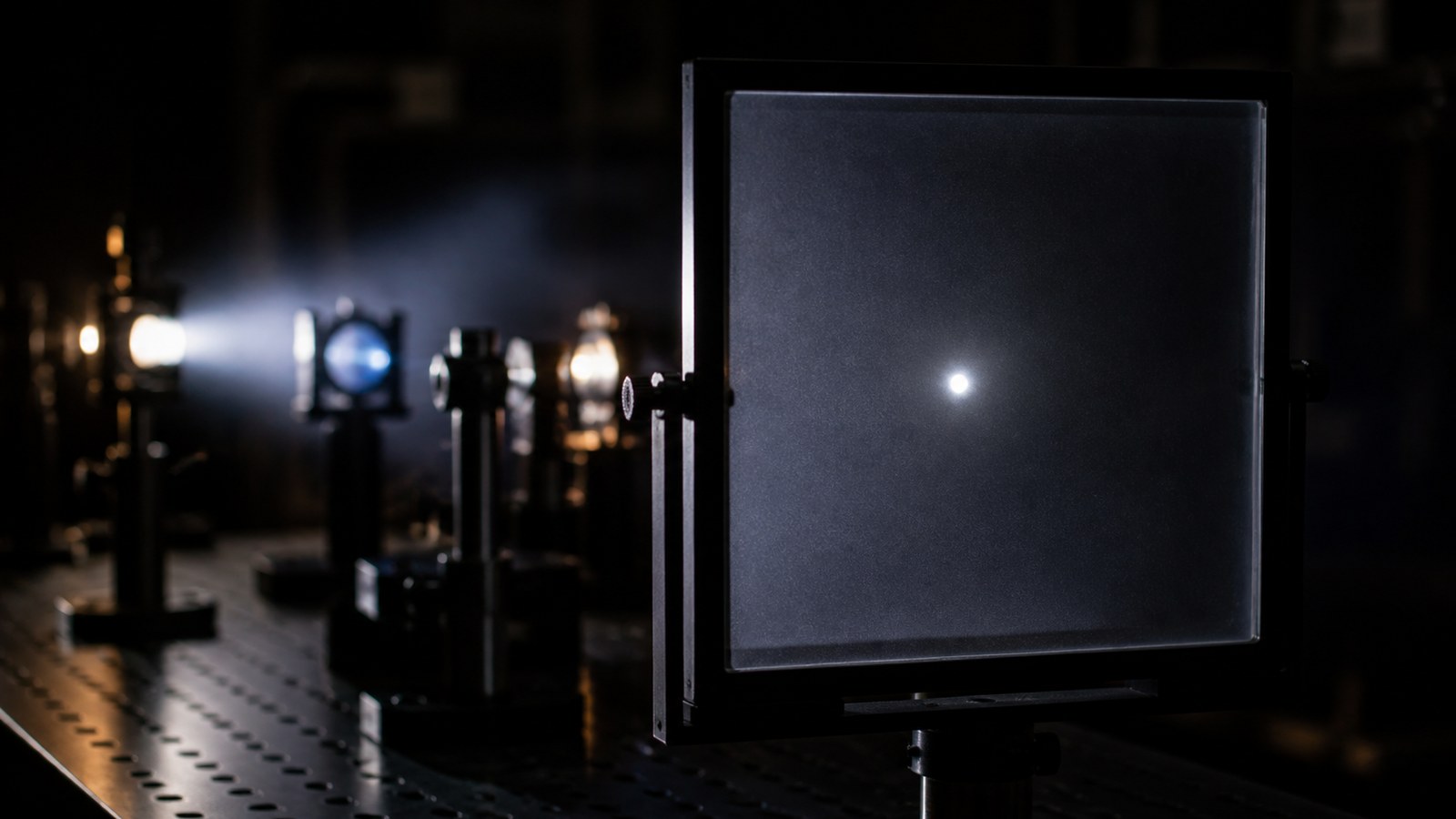
One measurement gives one definite outcome. Many measurements reveal the probability structure behind that outcome. This is why quantum experiments are repeated over and over with carefully prepared systems. A single dot on a detector matters, but the pattern formed by thousands of dots tells the deeper story.
Repetition also helps separate genuine quantum behavior from noise, drift, and equipment error. Experimental certainty is built from both quantum theory and laboratory discipline. The cleaner the preparation and measurement, the more clearly the predicted probabilities emerge.
In this sense, quantum science is not anti-certainty. It relocates certainty. Instead of promising perfect foresight for every individual event, it promises dependable rules for how events are distributed and how outcomes update future expectations.
That relocated certainty is enough to build atomic clocks, verify quantum chips, and test foundational ideas with numbers rather than vibes.
The Best Beginner Summary
Quantum measurements create certainty by turning a structured set of possibilities into a recorded result. The uncertainty before measurement is not ignorance in the ordinary sense, and the certainty afterward is not unlimited knowledge. It is a definite answer to a specific question asked by a specific physical arrangement.
That is enough to power real science. It lets physicists build devices, test theories, and compare results across laboratories. At the same time, it keeps the deeper mystery alive. Quantum mechanics tells us exactly how to predict the odds and update after the outcome.