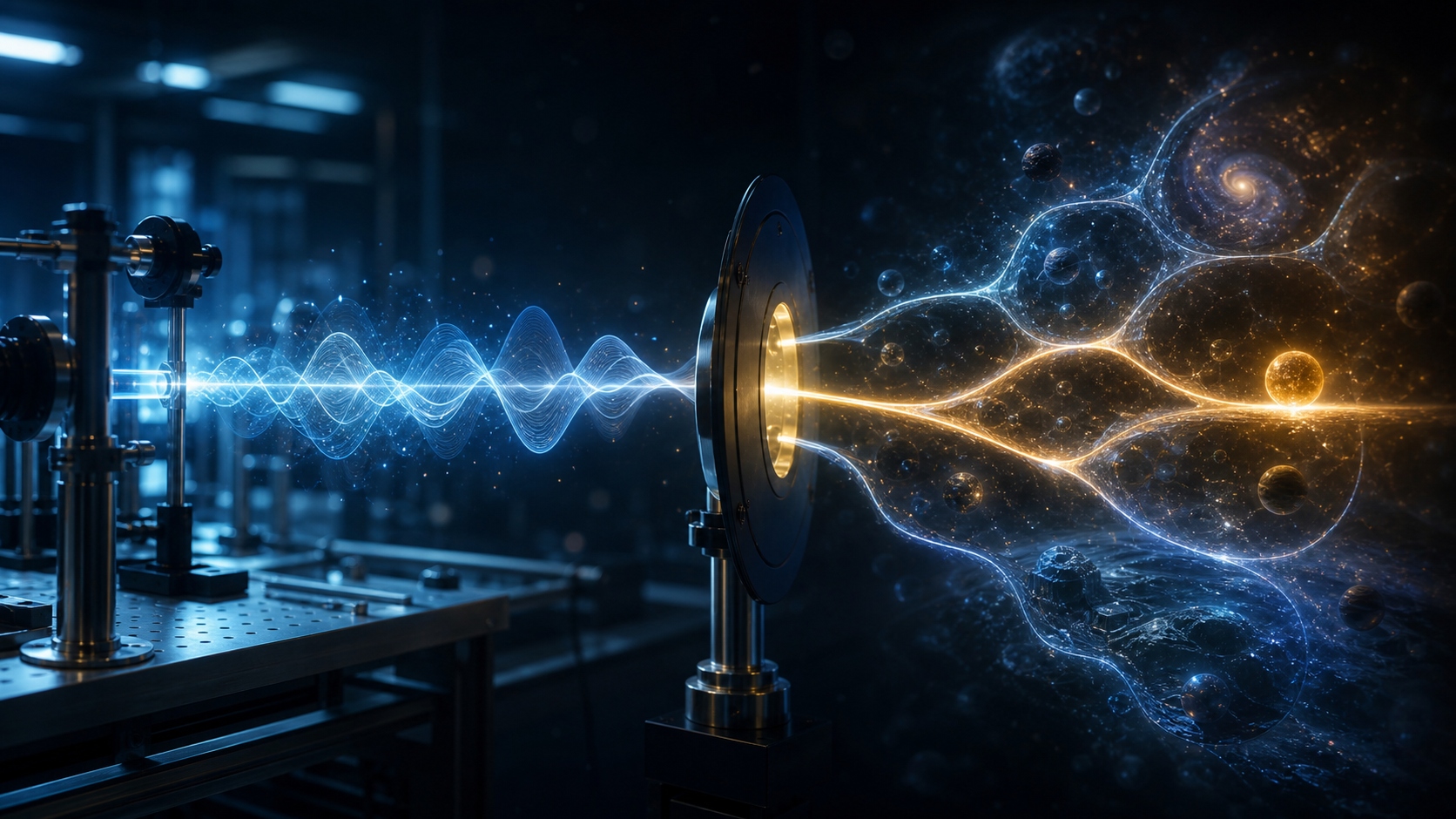
Watching a particle changes its behavior only when watching means measuring. A particle does not react to curiosity. It reacts to physical setups that can reveal where it went, what state it occupied, or which outcome occurred. The famous observer effect is really an information effect.
A: No. It responds to interactions.
A: Which-path information.
A: No. A stored record is enough.
A: No. It is about physical measurement.
A: An experiment about removing usable path information.
A: Yes, with weak measurements.
A: Not always; information availability is crucial.
A: Yes, if it stores information.
A: The paths become distinguishable.
A: Watching changes behavior when it creates a record.
The Popular Version Is Too Dramatic
The story is often told as if particles behave one way in private and another way when a person looks. That makes quantum physics sound like theater. The real story is better. A particle's behavior changes when the experiment includes equipment capable of storing information about it.
Which-Path Information Is the Switch
In a double-slit setup, interference appears when path alternatives remain indistinguishable. Add a device that can tell which slit the particle used, and the pattern changes. The switch is not attention; it is which-path information. Once the world contains evidence of the route, the alternatives stop combining in the same way.
A Detector Can Watch Without Being Watched
Suppose a detector records path information but nobody opens the data file. The experiment has still changed. The particle interacted with a device that now carries information. Quantum physics cares about the physical availability of that information, not about whether a person has emotionally noticed it.
Quantum Erasers Reveal the Subtlety
Quantum eraser experiments show that the issue is not merely rough disturbance. Under special conditions, if path information is made unavailable, interference-related patterns can reappear in sorted results. These experiments are subtle, but they point to the same lesson: what matters is whether alternatives are distinguishable in the physical record.
What Watching Does Not Mean
Watching does not mean mind control. It does not mean particles are conscious. It does not mean reality changes because someone is curious. Those claims distract from the actual science. The real effect comes from detectors, interactions, records, and experimental design.
The Scientific Answer
So yes, watching can change particle behavior, if watching means creating a physical measurement record. No, watching does not change behavior if it means merely thinking about a particle from across the room. Quantum weirdness begins when information becomes part of the experiment.