The Cat Is a Mirror for Interpretation
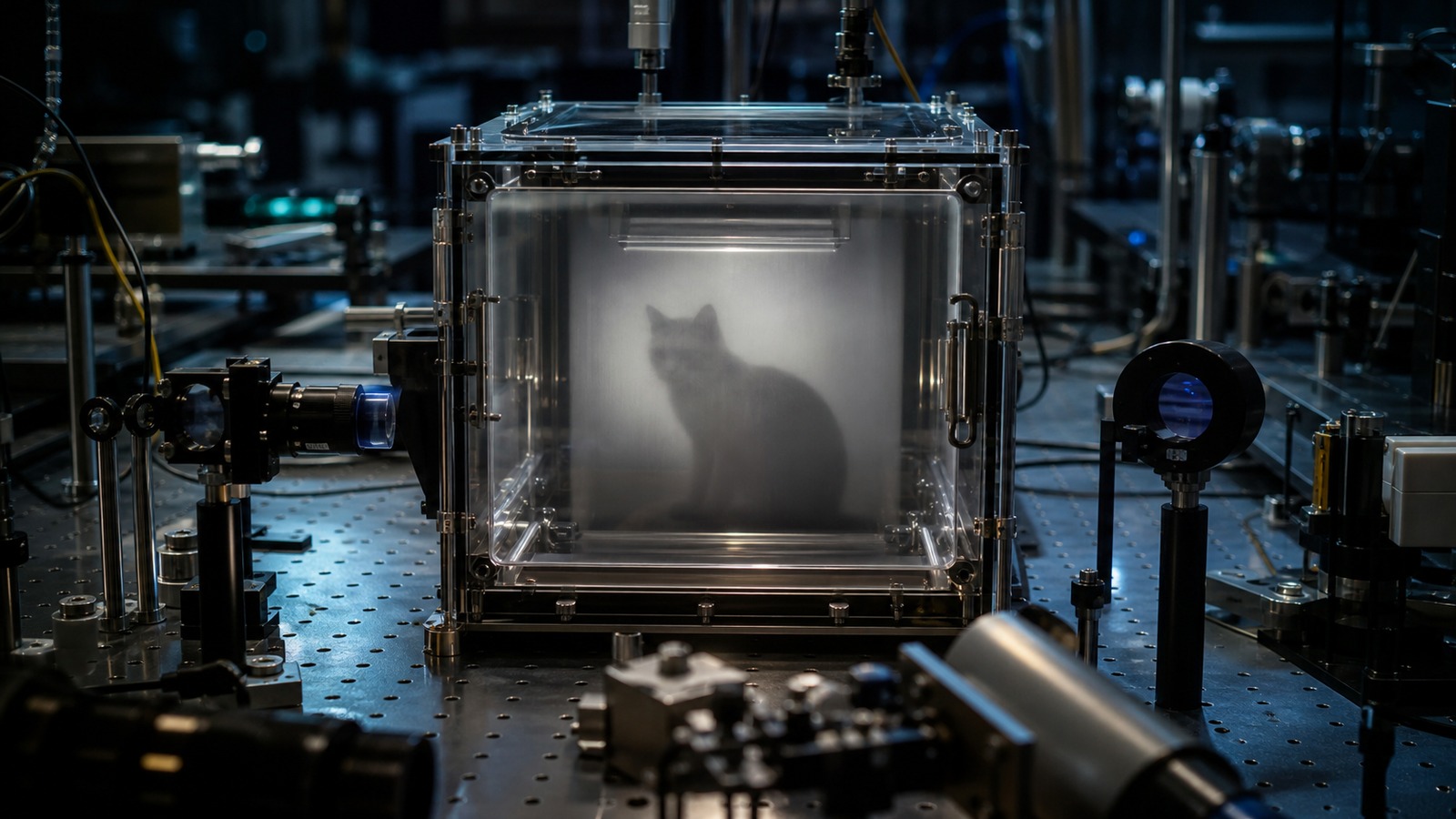
Schrodinger’s cat is one of the most famous images in quantum physics, but the point is often misunderstood. The thought experiment was not designed to prove that cats literally hover between life and death in ordinary rooms.
It was designed to expose a problem in the way quantum theory moves from microscopic possibilities to macroscopic facts.
In the story, a quantum event is connected to a device that would affect a cat inside a sealed box. If the quantum event is described as a superposition before anyone looks, does the larger box-and-cat system also have to be described as a superposition?
If so, when does one definite outcome appear?
Different interpretations answer that question in different ways. A Copenhagen-style account may emphasize the measurement context and the update of the state when a definite result is obtained. Many-Worlds may say both outcomes remain in separate branches.
Objective-collapse theories may say a real physical collapse prevents such macroscopic ambiguity from lasting. Bohmian mechanics may say the cat has a definite configuration all along, guided by the wavefunction.
Relational and information-centered approaches may say the state description depends on the system or agent assigning it. The cat matters because it forces each interpretation to say what counts as real, what counts as a measurement, and whether the wavefunction describes the world or our expectations about it.
That is why the example remains more than a famous classroom puzzle.
It compresses the entire measurement problem into a form that anyone can picture: a hidden quantum trigger, a macroscopic consequence, and an observer who eventually finds one record. The interpretations do not disagree about whether a record is found.
They disagree about what kind of physical or informational story leads to that record. Once that is clear, the cat becomes a comparison tool rather than a slogan.
A: It was a thought experiment designed to expose a conceptual problem.
A: Different interpretations answer differently, and most careful accounts avoid that simple slogan.
A: No. The practical focus is a definite measurement record.
A: It says different outcome records exist in different decohered branches.
A: It says real physical collapse prevents large superpositions from persisting.
A: It adds definite particle configurations guided by the wavefunction.
A: The sealed box isolates the outcome from ordinary knowledge until the setup is checked.
A: It explains stable records, but interpretations disagree about whether that is enough.
A: It turns the measurement problem into a vivid macroscopic image.
A: The cat asks what a quantum state means when applied to a whole measurement chain.
Why the Thought Experiment Was Invented
Schrodinger introduced the cat to dramatize a problem that was already present in the mathematics. Quantum theory can describe a microscopic system as a superposition of alternatives. A radioactive atom, for example, may be represented as undecayed and decayed before measurement.
If that microscopic state controls a macroscopic device, the mathematics seems to spread the superposition upward into the apparatus and the cat. The result looks absurd if we expect everyday objects to have one clear condition at every moment.
The thought experiment therefore asks where the quantum description stops. Is the cat merely unknown to us, like a coin hidden under a cup? Or is the whole situation genuinely described by a superposed quantum state until a record is made?
The answer depends on what an interpretation thinks the wavefunction is doing. That is why the cat became a doorway into quantum foundations rather than just a memorable story.
Copenhagen and the Practical Boundary
A Copenhagen-style reading usually treats the experiment as a warning against applying the wavefunction too naively to a whole everyday situation. The quantum state is used to calculate the probabilities for possible measurement outcomes. When the box is opened and a definite result is found, the state is updated.
The cat is not a magical animal in limbo; it is part of an experimental arrangement whose final outcome becomes a classical fact.
The strength of this approach is practical clarity. It matches how laboratories work: prepare a system, measure it, record the result, and update predictions. The weakness is that it can leave the boundary between quantum system and classical apparatus partly unexplained.
If the apparatus is made of atoms, and atoms obey quantum rules, why does the apparatus get to stand outside the superposition?
Copenhagen answers are often useful, but they can feel incomplete when the cat is used to push the boundary hard.
For beginners, the Copenhagen lesson is not that consciousness saves the cat. It is that quantum theory may be a tool for organizing what can be said about experiments, and that definite outcomes are treated as the anchor of the description.
Many-Worlds and the Branching Cat
Many-Worlds gives the most dramatic-sounding answer, although the disciplined version is more precise than the slogan. It says the wavefunction does not collapse when the box is opened. Instead, the atom, device, cat, box, environment, and observer become entangled.
Decoherence separates the outcome records into branches. In one branch, an observer sees one result; in another branch, a corresponding observer sees the other.
This removes the need for a special collapse rule. The same quantum law applies to the atom and the cat. The cost is accepting that the full quantum state contains more than one macroscopic outcome. The cat is not half-alive in one experienced world.
Rather, the branch structure contains different records, and each observer inside a branch experiences a definite cat. Many-Worlds turns the cat from a paradox about collapse into a question about why only one branch is accessible from inside experience.
Objective Collapse and a Physical Limit
Objective-collapse theories treat the cat as evidence that standard quantum mechanics may be missing a real physical process. These theories modify the dynamics so that superpositions collapse spontaneously under certain conditions, often more strongly for large or complex systems.
The cat never remains in a sustained macroscopic superposition because nature itself reduces the state before that picture becomes physically real.
The appeal is directness. A real collapse process explains why ordinary objects look definite without making observers special. The tradeoff is that new physics must be added, and that new physics must survive precision tests.
If collapse happens objectively, it may leave small detectable traces in experiments involving larger and larger quantum systems.
In this reading, the cat is not a philosophical embarrassment but a clue. It suggests that the quantum-to-classical transition might involve a real mechanism still waiting to be measured.
Bohmian Mechanics and Definite Configuration
Bohmian mechanics, or pilot-wave theory, says particles have definite positions at all times. The wavefunction guides their motion, but the cat’s physical configuration is never literally indefinite. The box may be described by a wavefunction with multiple branches, yet the actual configuration lies in one branch.
The cat has one definite condition even before the box is opened.
This gives the thought experiment a clear realist answer. There is no mystery about whether the cat has a state. The mystery moves to the guiding wave and its nonlocal structure. Bohmian mechanics pays for definite outcomes by adding underlying variables and accepting a deeper dynamics that differs from the classical picture.
The cat is definite, but the theory behind that definiteness is not simple classical common sense.
Relational and Information Views
Relational interpretations and information-centered views shift the question away from a single God’s-eye state of the cat. A relational account may say that the cat, device, observer, and outside scientist can have state descriptions relative to their interactions.
An information-centered view may treat the wavefunction as representing an agent’s expectations or commitments, so collapse becomes an update after an experience rather than a physical jump in the box.
These approaches can dissolve part of the paradox by asking who is assigning the state and from what physical relation or informational position. The cost is that they may feel less satisfying to readers who want one simple statement about the cat’s observer-independent condition.
Their value is that they expose how much of the puzzle comes from assuming that one state description must mean the same thing for every possible observer at every stage.
Why the Story Still Works
The cat story still works because it connects a tiny quantum event to a familiar macroscopic record. Many quantum puzzles stay hidden when they involve only electrons, photons, or abstract state vectors. The cat forces the reader to notice that measurement devices are also physical systems.
If the microscopic atom can be in a superposition, and the device is coupled to that atom, then the larger chain cannot be ignored by simply declaring it classical without explanation.
The story also keeps the difference between ignorance and superposition in view. If the cat were merely unknown, the box would be like a sealed envelope containing a prewritten answer. Quantum mechanics raises a sharper possibility: the state used before measurement may not be a list of hidden settled facts.
That distinction is exactly what interpretations must explain.
Some say the larger system really has a special quantum description; some say a deeper configuration is definite; some say the state assignment reflects available information.
Finally, the example works because it is uncomfortable. It pushes every view to be honest about its own cost. Copenhagen must explain the practical boundary, Many-Worlds must accept branches, collapse theories must add dynamics, Bohmian mechanics must accept hidden structure, and relational views must make peace with perspective-dependent state descriptions.
The cat does not settle the debate. It makes the price tags visible.
What the Cat Teaches Across Views
The cat thought experiment survives because it is not tied to one interpretation. It is a stress test. Every view has to explain how a microscopic quantum possibility becomes a macroscopic record. Every view has to say whether the wavefunction is real, informational, incomplete, relational, or only operational.
Every view has to handle the fact that nobody opens an actual box and sees a blurry half-result.