Observation Is Not A Magic Stare
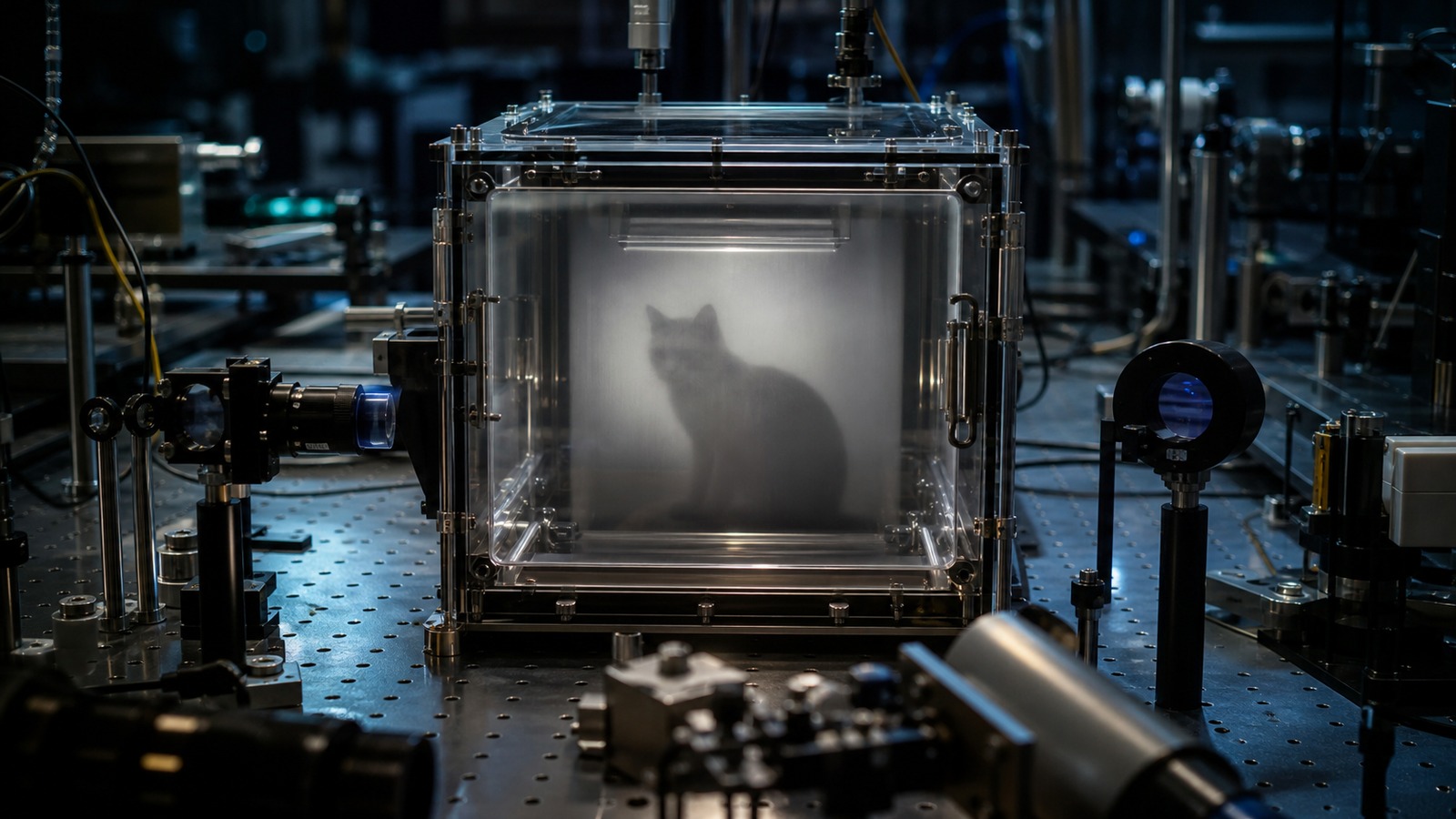
The question ‘does observation create reality?’ is one of the easiest ways to make quantum physics sound stranger than it needs to be. In the Copenhagen view, observation does not usually mean a conscious person staring reality into existence. It means a physical measurement: an interaction between a quantum system and an apparatus that produces a definite, recordable outcome. The mystery is real, but it is a disciplined mystery about measurement, not a supernatural claim about attention.
A: Standard Copenhagen does not require a mind; a physical measurement record is enough.
A: No. It is an interaction that produces a record.
A: No. It helps produce definite facts within an experimental context.
A: Yes, in the relevant physics sense.
A: The setup defines which quantum property is being tested.
A: Copenhagen warns against assuming ordinary definiteness before measurement.
A: No. It is about laboratory interactions, not personal belief.
A: Collapse represents the update from possible outcomes to the recorded result.
A: No. They explain pre-measurement reality differently.
A: Replace mystical observation language with physical measurement language.
Why The Word Observation Causes Trouble
In everyday speech, observation sounds passive. A person looks through a window, notices a bird, or checks the time. The object observed seems to have had its properties all along. Quantum measurement is different because the act of measuring can define the very property being asked about. The apparatus is not merely discovering an ordinary hidden label; it is part of the physical situation that makes a particular outcome meaningful.
This is why Copenhagen discussions can sound as if reality waits for a watcher. That phrasing is misleading. The relevant event is not private awareness but a public record: a spot on a screen, a detector click, a pointer position, a stored signal, or another irreversible mark. Once such a record exists, physicists can use it as a fact in the ordinary scientific sense.
The challenge is what to say before that record exists. The wavefunction may contain several possible outcomes with different probabilities. Copenhagen resists translating that mathematical spread into a simple story where the particle already had every familiar property in a classical way. Observation matters because it is where the possible outcomes meet a definite experimental result.
The trouble is amplified by popular retellings that compress a technical issue into a dramatic sentence. Saying ‘the observer creates reality’ is memorable, but it hides the apparatus, the interaction, the statistics, and the careful distinction between possible and actual outcomes. It also invites people to import ideas about belief, attention, or intention that are not part of the laboratory story. Copenhagen becomes much clearer when the human observer is removed from center stage and the measurement process is put there instead.
There is still a genuine puzzle after that correction. A detector is physical, and it is made of quantum matter too. Why, then, should it be treated as producing a definite outcome rather than becoming part of one vast superposition? Copenhagen handles this pragmatically by using classical language for the apparatus and recorded result. Critics see that as incomplete, but the pragmatic move is exactly what allowed the theory to be used so effectively.
The safest correction is linguistic: whenever the word observation appears, ask what physical process is meant. Was a detector coupled to the system? Was information amplified into a stable record? Was an incompatible measurement introduced? These questions replace a vague mental image with a laboratory description. Once that replacement is made, many exaggerated claims lose their force.
What Copenhagen Means By A Quantum Fact
A quantum fact is not just whatever someone imagines. It is an outcome produced under specified experimental conditions. If an apparatus is built to measure position, the recorded result belongs to that context. If a different apparatus is built to measure momentum, the question changes. Copenhagen insists that claims about quantum properties must be tied to the setup that makes those claims testable.
This view protects quantum physics from vague language. It prevents us from saying that a particle took a definite path when the experiment was designed to preserve interference between paths. It also prevents us from treating a wave-like description as if it were a literal water wave in space. The fact is real, but the route to the fact depends on how the system is prepared and measured.
The word fact also needs care. In ordinary life, a fact seems independent of how it is asked about. The height of a doorframe does not change because we choose a different ruler, assuming the measurement is done properly. Quantum facts are more contextual. The property recorded is inseparable from the measurement arrangement that brings it into focus. That does not make the fact subjective. It makes the physical conditions of the question part of the fact’s meaning.
That contextuality is subtle, but it is not a loophole for arbitrariness. The apparatus must be real, the interaction must happen, and the outcome must fit the statistical pattern predicted by the theory. Copenhagen’s emphasis on context narrows claims; it does not make every claim equally valid.
Does Reality Exist Before Measurement?
Copenhagen does not require the answer ‘no’ in a crude sense. Atoms, fields, and instruments are not fantasies. The issue is whether specific classical properties, such as a precise position or path, can always be assigned before the measurement that defines them. The Copenhagen answer is cautious: do not attribute more definiteness than the experimental situation supports.
That caution is especially important in interference experiments. If no which-path measurement is made, the outcome pattern reflects a combination of alternatives. If a which-path measurement is introduced, the pattern changes. The apparatus does not merely reveal a prewritten travel diary. It changes the kind of question nature is being asked and therefore changes the phenomena that appear.
Some people summarize this by saying measurement creates the outcome. That phrase can be useful if handled carefully. It means the definite result emerges in the measurement context. It should not mean that human belief creates external reality or that the world has no structure when unobserved.
Other interpretations answer the pre-measurement question differently. Many-Worlds says the universal wavefunction evolves without collapse, with different outcomes branching. Pilot-wave theory says particles have definite positions guided by a wave. Copenhagen remains more restrained, asking us to focus on what can be said from the actual experimental arrangement.
This is where Copenhagen sounds most radical and most easily misunderstood. It is not saying that nothing exists between experiments. It is saying that the full set of classical attributes we casually assign to ordinary things cannot automatically be assigned to quantum systems. A prepared electron may be described by a state that predicts several possible position outcomes. Treating one of those possible outcomes as secretly actual before the measurement may go beyond what the theory and experiment justify.
The issue becomes sharper when incompatible measurements are considered. An arrangement that reveals interference is not also an arrangement that reveals a definite path in the same classical sense. Trying to combine both descriptions into one picture can create confusion. Copenhagen asks us to respect the exclusiveness of certain experimental questions. That discipline is less exciting than the slogan, but it is much closer to the physics.
Copenhagen’s caution does not make the world flimsy. It makes certain property claims conditional. The difference is important. Saying that an electron lacks a definite measured position before a position measurement is not the same as saying nothing exists. It means the classical property language has to wait for the experimental context that gives it meaning.
Where Consciousness Entered The Story
Consciousness became attached to quantum measurement partly because words like observer and observation invite confusion. A few thinkers explored mind-centered readings, and popular culture amplified them. Standard Copenhagen practice does not need that addition. A detector can register a result before any person reads the data. The measurement problem is hard enough without turning every laboratory instrument into a philosophical drama about awareness.
The better distinction is between reversible microscopic evolution and the production of a stable record. Once information is amplified into the macroscopic world, the result can be checked, copied, and discussed. That transition is what matters for ordinary scientific use. Human consciousness arrives later as the way scientists learn about the record, not as the force that creates it.
It is true that human beings eventually read instruments, publish results, and argue about meanings. But that social layer sits on top of physical records. A cloud chamber track, a photodetector signal, or a mark on a plate can exist before a scientist studies it. The philosophical question is how such records become definite within a quantum world, not whether a person’s mind is a special cosmic switch.
The consciousness shortcut is tempting because it appears to explain definiteness by pointing to something familiar: our own awareness. But familiarity is not explanation. A scientific account has to say how physical systems interact, why records stabilize, and how predictions match statistics. Moving the mystery into the mind does not solve those tasks; it usually makes them harder to state clearly.
A Careful Answer To The Big Question
So does observation create reality? The careful Copenhagen answer is that measurement helps create definite quantum facts, but it does not create the universe from nothing. The apparatus, interaction, and record are physical. The result is real. What Copenhagen rejects is the assumption that every measured property had the same kind of definite classical value before the measurement.
This answer can feel less thrilling than the popular slogan, but it is much more useful. It keeps the strangeness where the experiments actually place it. Quantum physics challenges naive realism about microscopic properties; it does not show that wishful thinking controls matter.
For beginners, the key is to replace the phrase ‘a person observes’ with ‘a measurement interaction produces a record.’ That shift removes much of the fog while leaving the genuine puzzle intact. Copenhagen’s view of reality is not that facts are imaginary. It is that facts at the quantum scale are inseparable from the experimental conditions under which they become facts.
A useful analogy is legal evidence rather than imagination. A court does not create the past by admitting evidence, but it does define which claims can be established within a procedure. In Copenhagen, measurement does not create existence from nothing, but it defines which quantum claim has become an established physical outcome. The analogy is imperfect, yet it captures the procedural discipline better than the phrase ‘mind creates matter.’
Once that discipline is in place, the Copenhagen answer becomes both stranger and more sober. Stranger, because it denies that microscopic properties always wait in the background exactly as classical common sense imagines them. More sober, because it anchors every claim in a preparation, a measurement, and a record. Observation creates reality only if the phrase is translated into that careful language. Without the translation, it creates more confusion than insight.
That careful language leaves room for awe. A measurement is not just a mundane act of checking a value already written in microscopic ink. It is part of the physical production of a definite outcome from a range of quantum possibilities. The awe belongs there, in the disciplined meeting between possibility and record, not in the mistaken idea that attention alone commands reality.
That is the version worth carrying forward. It is careful enough for science, clear enough for beginners, and still strange enough to show why measurement remains one of the deepest problems in quantum theory. It protects the wonder without sacrificing precision or rigor.