Wave-Particle Duality: How Light and Matter Act Like Both
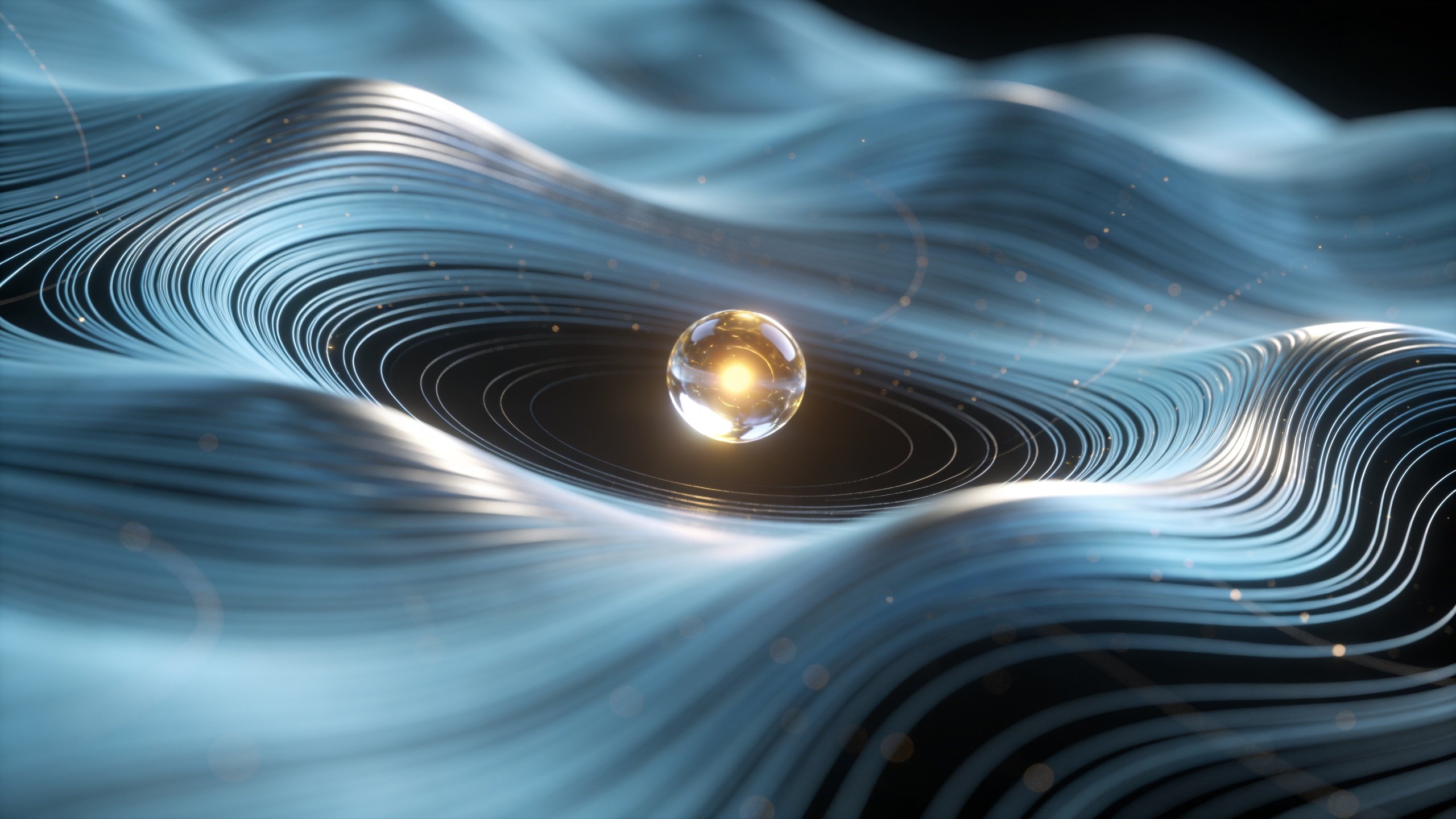
Wave-particle duality is one of the most mind-bending ideas in all of science. It challenges what we think we know about the world—how objects move, how light behaves, and even what “things” truly are. At first glance, waves and particles seem like opposites. Waves spread out, overlap, and flow through space. Particles are tiny, individual bits of matter that travel along specific paths. Yet in the quantum world, light and matter refuse to fit neatly into either category. They behave like waves and particles simultaneously, depending on how we observe them. This puzzling truth became the foundation of quantum mechanics and reshaped our understanding of reality.
A: Light behaves like a wave when it spreads and interferes, but like a particle when we measure individual photons.
A: Yes—electrons, atoms, and even molecules show wave behavior.
A: Measurement forces the quantum system into a definite state instead of a spread-out wave.
A: In theory yes, but their wavelengths are far too tiny to detect.
A: Overlapping probability waves produce bright and dark regions, even from single particles.
A: No—its effects help explain atoms, chemistry, electronics, and even vision.
A: Some interpretations suggest this, while others propose deeper mechanisms.
A: The effect is proven, but the meaning behind it is still discussed.
A: Qubits use superposition—made possible by wave-like behavior.
A: Think of particles as “probability clouds” that act like waves until forced into a single location.
The Classical View: Waves and Particles as Opposites
Before quantum theory emerged, scientists believed the universe operated according to well-defined rules. Light, with its colors, reflections, and interference patterns, was understood as a wave.
Newton once proposed that light might be made of particles, but the wave model ultimately dominated because it explained so many phenomena. Matter, on the other hand, was always seen as made of solid particles—atoms, molecules, and eventually electrons and protons.
These categories seemed clean and intuitive. Waves were continuous; particles were discrete. Waves could pass through each other; particles could collide. Waves had no definite position; particles were tiny objects with measurable locations. The universe seemed tidy and predictable. That tidy picture didn’t last.
Light as a Wave: The First Clues of Duality
In the 1800s, experiments like Thomas Young’s double-slit experiment provided overwhelming evidence that light behaved like a wave. When light passed through two tiny openings, it created an interference pattern—bright and dark bands—not two simple bright spots as particles would.
Only waves could interfere with each other this way. The experiment convinced physicists that light was unquestionably a wave. Yet the puzzle was far from solved.
Light as a Particle: Einstein’s Breakthrough
In 1905, Albert Einstein introduced a revolutionary idea. He showed that light sometimes behaved like a stream of particles called photons.
He used this idea to explain the photoelectric effect, where light shining on metal ejects electrons. Classical wave theory said the brightness of the light should determine whether electrons were released. But experiments showed that frequency—the color of the light—mattered, not brightness. Only high-frequency light could knock electrons loose. Einstein concluded that light must arrive in individual “packets” of energy—particles.
This discovery earned him the Nobel Prize and marked a turning point in physics. Light was a wave in some situations and a particle in others. Duality wasn’t a glitch; it was a fundamental property of nature.
Matter Joins the Story: The Wave Behavior of Particles
Light acting like a particle was surprising enough, but the next discovery pushed science into truly strange territory. In 1924, French physicist Louis de Broglie made a bold claim: if light, traditionally thought of as a wave, could behave like a particle, then particles like electrons might also behave like waves.
His idea was quickly tested and confirmed. When electrons were fired at a crystal or through a double slit, they produced interference patterns just like waves. This meant matter, the solid stuff that makes up everything around us, also had wave-like properties. Wave-particle duality wasn’t limited to light. It applied to everything.
The Quantum Wavefunction: A New Way to Describe Reality
As duality became accepted, physicists needed a new mathematical framework to describe these strange behaviors. Erwin Schrödinger provided it in 1926 with the wavefunction. Instead of describing particles as tiny billiard balls, the wavefunction describes them as clouds of possibilities. These waves don’t represent physical ripples in space but probability waves—mathematical functions that show where a particle is likely to be found. The wavefunction spreads out like a wave, interferes like a wave, and collapses into a single location when measured.
It elegantly combines the wave and particle behaviors into one unified picture. The wavefunction doesn’t tell us exactly where a particle is until we measure it. It only tells us the likelihood of where it could be. This probabilistic nature was shocking at the time and remains deeply counterintuitive today.
Observation Matters: The Role of the Observer
One of the strangest consequences of wave-particle duality is the role of observation. In quantum experiments, particles behave like waves when not observed directly. But when we measure them—when we look for their position—they behave like particles. In the double-slit experiment, if detectors monitor which slit a particle passes through, the interference pattern disappears. The particle acts as if it chose only one path. Without observation, the particle behaves like a spread-out wave that travels through both slits at once. This effect doesn’t require a human observer—any measuring device breaks the wave-like behavior.
The very act of measurement forces the quantum system to “choose” a single outcome. This idea has sparked philosophical debates for decades. Does reality exist in definite form only when measured? Do particles take all possible paths until forced into one? Quantum mechanics does not answer why this happens—it only predicts what happens with incredible accuracy.
The Double-Slit Experiment: The Ultimate Demonstration of Duality
The double-slit experiment remains the most famous demonstration of wave-particle duality. When particles such as electrons are shot one at a time toward two slits, something astonishing happens.
Even when fired individually, the electrons build up an interference pattern over time. Each electron seems to behave like a wave, passing through both slits simultaneously and interfering with itself.
Yet when we detect which slit it travels through, it behaves like a particle, choosing one path and eliminating the interference pattern. It’s as if nature allows electrons to explore multiple paths but reveals only a single outcome when measured. The experiment has been repeated with photons, atoms, and even molecules containing hundreds of atoms. The wave-like behavior of matter persists, demonstrating that duality is universal.
Why Wave-Particle Duality Matters for Modern Science
Wave-particle duality isn’t just an abstract idea—it forms the backbone of modern technology. Quantum mechanics, built on the foundation of duality, powers many devices in use today. Semiconductors rely on quantum behavior to control the flow of electrons, enabling computers, smartphones, and nearly all electronics.
Lasers work because photons behave like particles with precise energy levels. MRI machines use quantum effects in atomic nuclei to create detailed images of the human body. Even emerging technologies like quantum computing are possible because particles can exist in multiple states at once, a direct result of wave-like behavior. Duality explains why electrons occupy specific energy levels in atoms, why chemical bonds form, and why materials conduct electricity. Without wave-like matter, the periodic table wouldn’t work, molecules wouldn’t form correctly, and life as we know it couldn’t exist.
The Strange Nature of Reality: What Duality Suggests About the Universe
Wave-particle duality raises profound questions about the nature of existence. How can something be both a localized particle and a spread-out wave?
How can observation change the outcome of an experiment? One interpretation suggests that particles aren’t physical things until measured—they exist as probabilities. Another proposes that particles do take every possible path, but we only experience one version of reality. Some physicists argue that duality reflects a limitation in human concepts. Waves and particles are classical ideas, and quantum objects simply don’t fit either category.
Quantum entities are something entirely new, and “wave” and “particle” are just convenient metaphors. What’s clear is that duality reveals the universe operates on rules very different from the everyday world. Our intuition, shaped by human-scale experiences, doesn’t apply at the quantum level.
How Duality Connects to Other Quantum Phenomena
Wave-particle duality is deeply tied to other quantum effects. Quantum superposition—the ability of particles to exist in multiple states—arises from their wave-like nature.
Quantum tunneling, where particles pass through barriers they shouldn’t be able to cross, is also explained by probability waves. Entanglement, where particles share linked states across distances, depends on wavefunctions that describe systems collectively rather than individually.
Duality is not an isolated quirk—it’s a universal feature of the quantum world. Understanding it opens the door to a broader understanding of quantum mechanics as a whole.
Does Duality Apply to Large Objects?
A natural question arises: if electrons behave like waves, do larger objects like grains of sand or people experience wave-particle duality? In theory, yes. Quantum mechanics says everything has a wavelength. But the wavelength of a large object is unimaginably tiny—far too small to detect.
The wave-like behavior becomes significant only for very small particles with low mass. However, researchers continue to push boundaries by demonstrating wave-like interference with increasingly large molecules. As technology improves, the line between quantum behavior and classical behavior becomes more fascinating and complex.
How Duality Shapes Our Understanding of Knowledge
Wave-particle duality doesn’t just reshape physics—it reshapes how we understand knowledge itself. It forces us to confront the idea that reality is not always absolute. At the quantum level, outcomes are described by probabilities, not certainties.
Knowledge becomes inherently limited. We can predict likelihoods with incredible accuracy, but we cannot know specific outcomes until they occur. This unpredictability is not due to faulty instruments but is built into the laws of physics. For centuries, scientists believed that with enough information, everything could be predicted. Quantum mechanics shattered that belief.
The Ongoing Mystery: Why Does Duality Exist?
Even though wave-particle duality is well established experimentally, physicists still debate its deeper meaning. Why does nature use this dual behavior?
Is duality a hint of an even more fundamental theory yet to be discovered? Some researchers believe quantum fields are the ultimate reality, with particles being excitations—localized ripples—within these fields. Others believe hidden variables or alternate universes may offer better explanations.
Despite the mysteries, duality remains one of the best-tested ideas in all of science. Every experiment confirms its predictions.
Wave-Particle Duality in Everyday Life
Although quantum effects are often portrayed as distant or abstract, they play a role in everyday life. The color of the sky, the glow of a light bulb, the function of our eyes, and the chemical reactions within our bodies all depend on quantum behavior. When sunlight strikes atoms in the atmosphere, photons interact with electrons in ways that depend on particle-like properties.
The colors we perceive arise from transitions between quantum energy levels. Even the stability of atoms depends on electron wavefunctions. Without wave-particle duality, matter would collapse, light would behave differently, and the world would be unrecognizable.
Teaching Duality: Helping Non-Scientists Understand the Quantum World
Explaining wave-particle duality to non-scientists can be challenging, not because the concepts are impossibly complex, but because they conflict with everyday intuition.
The key is to focus on analogies while remembering that analogies are imperfect. One way to think of quantum particles is as “probability clouds” that behave like waves until we interact with them. Another approach is to compare quantum objects to musical notes—something that exists both as a specific pitch (particle-like) and as a spread-out waveform (wave-like). What matters most is recognizing that quantum mechanics describes a world where old categories no longer apply.
The Future of Quantum Research
Wave-particle duality continues to drive scientific curiosity and technological innovation. As experiments become more precise, researchers hope to uncover how quantum behavior transitions into the classical world we see every day.
Upcoming technologies like quantum computers, ultra-precise sensors, and advanced materials rely heavily on quantum principles rooted in duality. Understanding duality more deeply may also shed light on unresolved mysteries such as dark matter, the origins of the universe, and the nature of spacetime.
Conclusion: The Universe Is More Mysterious—and More Beautiful—Than We Imagined
Wave-particle duality reveals a universe far more mysterious, flexible, and astonishing than classical physics ever predicted. Light is neither purely a wave nor purely a particle. Matter behaves like both depending on how we interact with it. At the heart of reality lies a world where possibilities ripple, paths overlap, and outcomes emerge only when observed. This duality challenges our assumptions but also enriches our understanding. It invites us to see the cosmos not as a mechanical clock but as a dynamic interplay of waves, probabilities, and unexpected behaviors. For non-scientists, the beauty of wave-particle duality lies in its reminder that the universe still holds wonders beyond our everyday experience. For scientists, it remains a guiding principle in the quest to understand nature at its deepest levels. Either way, wave-particle duality stands as one of the most profound ideas in human history—a testament to our ability to question, explore, and uncover the hidden truths of existence.