
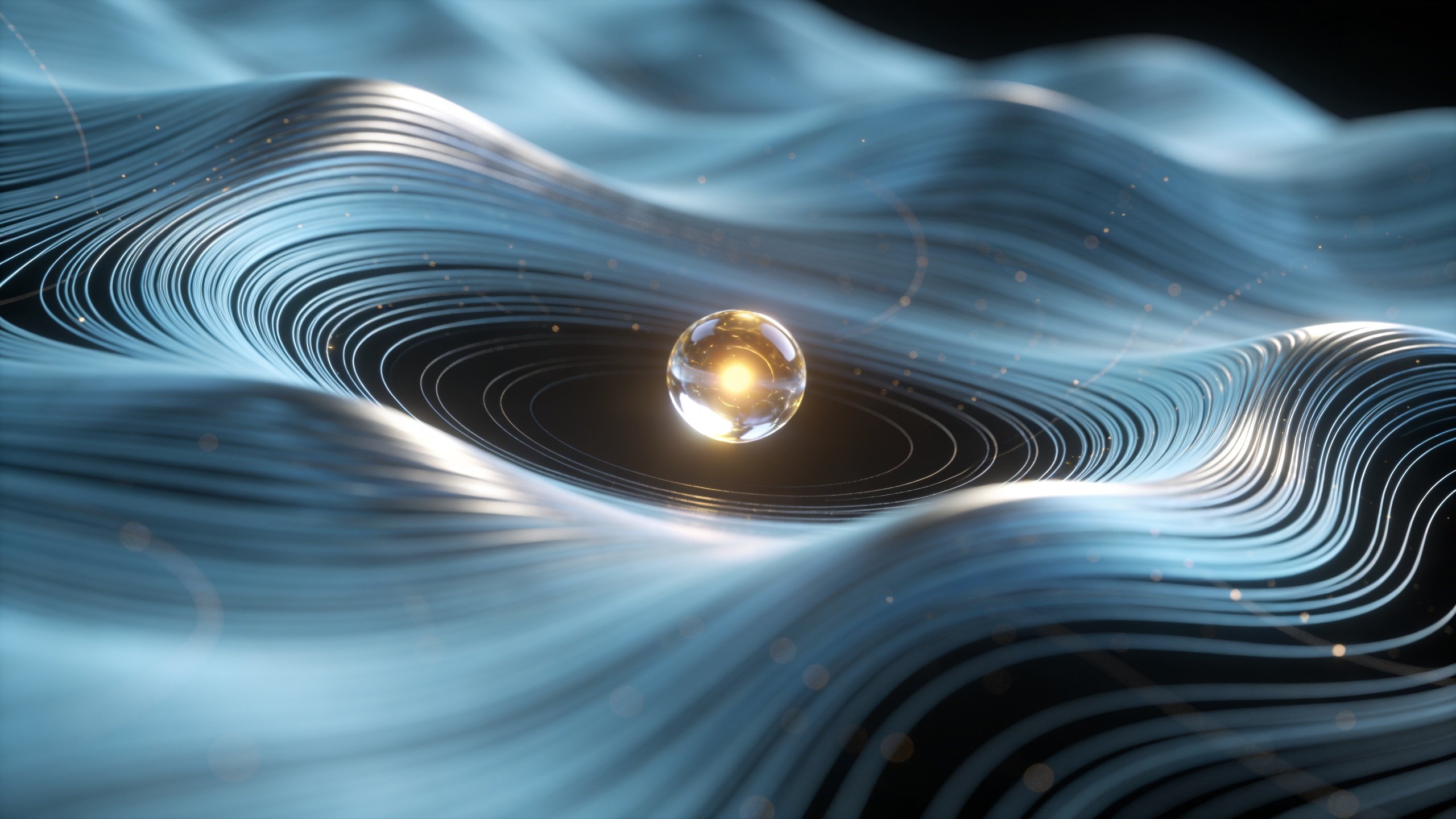
The Rule That Turns Mystery Into Numbers
Quantum physics is famous for sounding strange. Particles seem to act like waves. Objects appear to exist in several possible states before they are measured. Experiments suggest that nature does not always reveal a single fixed answer until the moment we ask the right question. Yet behind all this mystery is one of the most reliable prediction tools in science: the Born Rule. The Born Rule is the rule that tells physicists how to turn a quantum wave into a probability. It does not usually say, “This exact thing will happen.” Instead, it says, “Here are the possible things that can happen, and here are the odds for each one.” That may sound less satisfying than certainty, but it has become one of the most successful ideas in modern physics.
A: It is the quantum rule that turns a wavefunction into probabilities for measurement outcomes.
A: It is named after physicist Max Born, who helped develop the probability interpretation of quantum mechanics.
A: Not usually. It predicts the chances of different possible results.
A: A wavefunction is a mathematical description of the possible states of a quantum system.
A: Squaring turns quantum amplitudes into ordinary probabilities that can be measured.
A: In standard quantum physics, it appears to be more than ignorance; it is part of how nature behaves.
A: It tells us how likely each measurement result is before one outcome appears.
A: Yes. It supports quantum predictions used in electronics, lasers, chemistry, imaging, and quantum computing.
A: The rule works extremely well, but scientists still debate what it means about reality.
A: It is the rule that tells quantum physics how to calculate the odds of what we will observe.
Why Quantum Physics Needs Probability
In everyday life, probability usually means uncertainty because we lack information. If you roll a die, you may not know which number will land face up, but you assume the die follows ordinary physical laws. If you knew every tiny detail about the throw, the table, the air, and the motion of your hand, you might imagine predicting the result perfectly. Quantum physics is different. In the quantum world, probability does not seem to be merely a sign of ignorance. It appears to be woven into how nature behaves. Before measurement, a quantum object is described by a wavefunction, which contains information about possible outcomes. The Born Rule explains how to read that wavefunction and calculate the chance of each outcome.
What Is the Born Rule?
The Born Rule is named after Max Born, one of the founders of quantum mechanics. In simple terms, it says that the probability of finding a quantum object in a particular state is given by the square of the wavefunction’s amplitude for that state. The wavefunction itself can be thought of as a mathematical description of possibilities, not a visible wave in ordinary space.
A helpful way to picture this is to imagine a glowing map of possible results. Some regions glow faintly, while others glow brightly. The Born Rule says that the brighter regions are more likely to show up when a measurement is made. But the rule adds an important twist: the brightness is not just the wave value itself. It comes from squaring the wave’s amplitude, which turns the quantum description into real-world probabilities.
The Wavefunction: A Catalog of Possibilities
The wavefunction is one of the central ideas in quantum physics. It describes what can be known about a quantum system, such as an electron, photon, atom, or molecule. It may tell us where a particle could be found, what energy it could have, or how its spin might be measured. For non-scientists, the wavefunction can be imagined as a kind of possibility cloud. It does not mean the particle is simply hiding somewhere inside the cloud like a tiny marble. Instead, the cloud describes the pattern of possible answers nature may give when we perform a measurement. The Born Rule tells us how to translate that cloud into odds.
Why Squaring Matters
One of the most unusual parts of the Born Rule is the square. In ordinary language, we might expect the wavefunction to directly tell us probability. But quantum amplitudes are not ordinary probabilities. They can be positive, negative, or even complex numbers, which involve mathematical values beyond the normal number line.
Probabilities, however, must be ordinary usable numbers. They cannot be negative, and they must add up properly. Squaring the amplitude solves this problem. It turns the strange mathematical information in the wavefunction into numbers that match experimental results. This is one reason the Born Rule is so powerful: it acts like a bridge between the hidden mathematical world of quantum theory and the visible world of laboratory measurements.
A Simple Example: Finding an Electron
Imagine an electron inside a box. Before measurement, quantum physics does not say the electron has one exact location in the ordinary sense. Instead, it is described by a wavefunction spread across the box. Some areas may have a high amplitude, while others may have a low amplitude.
When we measure the electron’s position, we find it in one specific place. The Born Rule tells us the probability of finding it in each region. If the wavefunction is stronger near the center of the box, the electron is more likely to be detected there. If the wavefunction is weaker near the edges, detection there is less likely. The rule does not predict the exact individual result every time, but it predicts the pattern that appears after many measurements.
Probability Does Not Mean Random Guessing
It is easy to misunderstand the Born Rule as saying quantum physics is vague or incomplete. But the rule is not a shrug. It is a precise mathematical instruction. Given the right wavefunction, physicists can calculate probabilities with extraordinary accuracy.
This is one reason quantum mechanics is both mysterious and dependable. It may not always offer certainty for a single event, but it gives remarkably accurate predictions for large numbers of events. In experiment after experiment, the probabilities predicted by the Born Rule line up with what scientists observe.
The Casino Analogy, With a Quantum Twist
A casino can predict that a roulette wheel will favor certain patterns over time, even though it cannot know the outcome of every spin in advance. Quantum physics also predicts patterns across many repeated measurements. But the analogy only goes so far. In a casino, randomness usually comes from practical complexity. In quantum physics, the randomness appears deeper. The Born Rule does not describe a machine we simply fail to understand. It describes a world where possible outcomes are built into the structure of physical reality, at least according to the standard interpretation of quantum mechanics.
Measurement: Where Possibility Becomes Result
The Born Rule becomes most important when a measurement happens. Before measurement, a quantum system may be described as a combination of possible states. After measurement, we observe one result. This transition from many possibilities to one outcome is one of the great puzzles of quantum theory.
The Born Rule does not fully explain why measurement produces one result rather than another. Instead, it tells us the odds of each possible result. It is like a rule for reading the menu of possibilities. The deeper question of what measurement really means has led to many interpretations of quantum physics, from the Copenhagen interpretation to many-worlds theory and beyond.
The Double-Slit Experiment and Probability Waves
One of the most famous demonstrations of quantum behavior is the double-slit experiment. When particles such as electrons are sent toward two narrow openings, they create an interference pattern, much like waves of water passing through two gaps. But when scientists detect each particle, it appears as a single dot on a screen.
The Born Rule explains the final pattern. The wavefunction spreads through the experiment and interferes with itself, creating regions where detection is more likely and regions where detection is less likely. Each electron lands in one spot, but after many electrons are measured, the probability pattern appears. This is quantum probability made visible.
Why Interference Makes Quantum Probability Special
Quantum probability is not the same as ordinary probability because quantum amplitudes can interfere. In everyday probability, if there are two ways something can happen, we often add the probabilities. In quantum physics, we add amplitudes first, and then apply the Born Rule.
This difference is enormous. Amplitudes can reinforce each other or cancel each other out. That is why quantum systems can produce interference patterns. The Born Rule turns the final combined amplitude into measurable probability, but the path to that probability is unlike anything in ordinary common sense.
Max Born’s Revolutionary Insight
Max Born proposed his probability interpretation in the 1920s, during the dramatic birth of modern quantum mechanics. At the time, physicists were trying to understand what the new wave equations actually meant. Were they describing real waves? Matter waves? Hidden motion? Or something else entirely?
Born’s insight was that the wavefunction should be understood probabilistically. It did not directly describe a smeared-out physical substance. Instead, it gave probabilities for what could be observed. This idea helped shape quantum mechanics into the practical, predictive theory scientists use today.
Why Einstein Was Uncomfortable
Albert Einstein helped launch quantum theory, but he was famously uncomfortable with the idea that probability might be fundamental. He believed that physics should describe an objective reality with clear causes behind events. The Born Rule, especially when paired with the standard interpretation of quantum mechanics, seemed to suggest that nature itself was not fully deterministic. Einstein’s discomfort was not simple stubbornness. He was asking a profound question: does quantum probability reflect genuine randomness, or does it hide a deeper layer of reality? That debate still echoes through modern physics. The Born Rule sits at the center of it because it is the rule that makes quantum randomness mathematically useful.
The Born Rule and Quantum Superposition
Superposition is the idea that a quantum system can be described as a combination of different possible states before measurement. For example, a particle’s spin might be described as a combination of “up” and “down” possibilities. This does not mean the particle is secretly choosing one while we are not looking, at least not in the simplest standard view.
The Born Rule tells us how likely each result is when we finally measure. If the wavefunction gives stronger weight to “up,” then “up” is more likely. If it gives equal weight to “up” and “down,” each result has equal probability. Superposition supplies the possibilities; the Born Rule supplies the odds.
A Non-Technical Picture of Amplitude
To understand amplitude without heavy math, imagine a stage with several spotlights aimed at different possible outcomes. A brighter spotlight does not guarantee that outcome will happen, but it makes that outcome more likely. The Born Rule is the instruction for converting spotlight strength into probability.
However, quantum spotlights have a strange feature: they can combine in ways that brighten or darken each other. Two possibilities can reinforce each other, making a result more likely, or cancel each other, making it unlikely or even impossible. This is why the quantum world behaves so differently from a world of ordinary dice and coins.
How the Born Rule Powers Modern Technology
The Born Rule is not just a philosophical idea. It is part of the machinery behind technologies that depend on quantum mechanics. Semiconductors, lasers, magnetic resonance imaging, electron microscopes, and quantum computing all rely on the ability to predict quantum behavior.
Whenever scientists need to know where electrons are likely to be, how atoms will absorb light, or what result a quantum measurement may produce, the Born Rule is nearby. It helps translate quantum theory into engineering, chemistry, materials science, and information technology.
Quantum Computing and Probabilities
Quantum computers use quantum bits, or qubits, which can exist in superpositions of states. The power of quantum computing comes partly from the way amplitudes can be arranged to interfere. Good outcomes can be amplified, while wrong outcomes can be reduced.
At the end of a quantum computation, the system must still be measured. That measurement produces ordinary classical information, such as a string of zeros and ones. The Born Rule determines the probability of each possible output. In this way, even futuristic quantum computers rely on the same probability rule developed during the early days of quantum theory.
The Difference Between Prediction and Control
The Born Rule gives probabilities, not total control. This is an important distinction. A physicist may know that one result has a 70 percent chance and another has a 30 percent chance, but that does not mean they can force the next single event to follow the 70 percent option.
This can feel frustrating, but it is also what makes quantum physics honest. It tells us exactly what kind of prediction nature allows. Instead of pretending to provide certainty where certainty may not exist, the Born Rule provides a precise map of likelihood.
Does the Born Rule Explain Reality?
The Born Rule is incredibly successful, but scientists and philosophers still debate what it means. Some interpretations treat the wavefunction as a tool for predicting observations. Others treat it as something physically real. Some suggest that all possible outcomes occur in branching realities, while others search for deeper mechanisms beneath quantum probability.
The rule itself works across interpretations. Whether someone believes in wavefunction collapse, many worlds, hidden variables, or other approaches, they must still explain why measurements follow the probabilities given by the Born Rule. That is why the Born Rule is not merely a formula. It is a gatekeeper for any serious interpretation of quantum mechanics.
Why the Rule Feels So Strange
The Born Rule feels strange because human intuition evolved in the world of large objects. Chairs, cars, baseballs, and planets do not appear to exist as clouds of possibility. They seem to have definite locations and definite properties. Our brains are trained by this everyday world.
Quantum systems live by different rules. At small scales, possibility is not just a lack of knowledge. It has structure. It evolves. It interferes. It becomes measurable through probability. The Born Rule gives us the language to describe that process, even when our imagination struggles to picture it.
The Power of Repeated Experiments
One measurement may look random. Ten measurements may look noisy. But thousands or millions of measurements reveal the hidden order of quantum probability. The Born Rule shines in these repeated experiments because it predicts the long-term pattern.
This is similar to flipping a coin. A single flip cannot prove much, but many flips reveal whether the coin is fair. In quantum physics, repeated measurements reveal whether the wavefunction and the Born Rule are correctly describing the system. Again and again, experiments show that they are.
Probability as a New Kind of Law
Classical physics often sounds like a clockwork universe. If you know the starting conditions, you can predict the future. Quantum physics offers a different kind of law. It says the future may not be fixed in every detail, but the probabilities are not chaotic. They follow strict rules.
The Born Rule is one of those strict rules. It does not destroy scientific prediction. It changes what prediction means. Instead of giving one guaranteed answer, quantum physics gives a probability structure so accurate that it can be tested to extraordinary precision.
The Born Rule in Plain English
In plain English, the Born Rule says this: quantum physics describes possible outcomes with a wavefunction, and the chance of seeing any outcome depends on the squared size of its wavefunction amplitude. Bigger amplitude means higher probability. Smaller amplitude means lower probability.
That simple idea carries enormous weight. It explains why quantum experiments produce patterns. It helps physicists calculate the behavior of atoms and particles. It supports technologies that shape modern life. It also forces us to rethink what it means to predict reality.
Why It Matters Beyond Physics
The Born Rule matters because it shows that uncertainty can be exact. In ordinary life, uncertainty often feels like confusion. In quantum physics, uncertainty can be measured, calculated, and tested. That is a powerful lesson.
It also reveals that the universe is not always predictable in the way people once imagined. Nature may not be a story with every detail written in advance. It may be more like a deep field of structured possibilities, where probabilities are not weaknesses in knowledge but features of reality itself.
The Quiet Heart of Quantum Mechanics
The Born Rule does not receive as much popular attention as Schrödinger’s cat, parallel universes, or quantum entanglement. It is less dramatic on the surface. But it is one of the quiet rules that makes the entire theory work.
Without the Born Rule, the wavefunction would be difficult to connect to real experiments. With it, quantum mechanics becomes a prediction engine of astonishing power. It tells scientists how to move from mathematical possibility to measured reality.
Conclusion: The Mathematics of Maybe
The Born Rule is the mathematics of maybe. It does not remove the mystery from quantum physics, but it gives mystery a structure. It shows how a universe of possibilities can produce reliable patterns, measurable results, and technologies that transform everyday life. For non-scientists, the most important idea is this: quantum physics does not always predict exactly what will happen next. Instead, it predicts the odds with remarkable precision. The Born Rule is the rule that makes those odds possible. It is one of the clearest windows into a universe where probability is not a failure of knowledge, but a fundamental part of how reality speaks.


