Why Seeing Superposition Is Not Like Seeing a Chair
Humans can see the evidence for superposition, but we cannot see superposition directly in the same way we see a chair, a spark, or a dot on a detector. Vision itself is a measurement process. Light enters the eye, triggers molecules in the retina, sends signals through nerves, and creates a stable perceptual record. By the time something is part of ordinary sight, delicate quantum alternatives have usually interacted with many surrounding systems. Superposition is different from a visible double exposure. It is a state relationship that can involve amplitudes, phase, and possible measurement outcomes before one definite record appears. That does not make it unreal or imaginary. It means the evidence must be gathered indirectly. Interference patterns, qubit readout statistics, atom interferometers, superconducting circuits, and matter-wave experiments all reveal behavior that requires coherent alternatives. We see the records produced by instruments, not the full pre-measurement state itself. This is normal in science. We do not see magnetic fields directly either, yet we infer them from reliable effects. For beginners, the best answer is careful: humans may never view superposition as an ordinary object, but we can observe its consequences with remarkable precision.
A: Not as an ordinary visible object; we see its evidence.
A: Seeing requires interactions that create records.
A: They are strong evidence when controls support the interpretation.
A: No. It records one outcome from one measurement.
A: A camera is also a measuring device.
A: The state is revealed through the distribution of many records.
A: They help only if treated as representations.
A: They can make evidence more vivid, not ordinary sight of the state.
A: Not when it is controlled, repeated, and predictive.
A: We observe superposition through measurable consequences, not naked-eye inspection.
What Direct Seeing Would Require
To see something directly, ordinary vision needs stable light, surface interaction, and a record in the eye and brain. Those steps are physical measurements. They are excellent for everyday objects, but they are harsh for fragile quantum superpositions.
If a superposition depends on alternatives remaining unmarked, scattering enough light to see it can destroy the very coherence being investigated. The act of making it visible in the everyday sense often creates records that remove the clean state relationship.
This is why the question is not about weak eyesight. It is about the incompatibility between ordinary seeing and preserving delicate quantum alternatives.
Why Detectors Show One Result
A detector usually gives a definite record: one click, one spot, one voltage, one readout value. That record is exactly what makes the result usable. It is also why the detector does not display the whole superposition in one glance.
The pre-measurement state may have shaped the probabilities, but the final record is specific. To learn about the state, scientists repeat the preparation many times and analyze the pattern of outcomes.
How Experiments Reveal What Eyes Cannot
Experiments reveal superposition by showing effects that ordinary hidden alternatives cannot explain in the same way. Interference is the most famous example. A pattern changes when coherent alternatives are allowed to recombine and disappears when which-path information is introduced.
Qubit experiments reveal superposition through controlled gates and readout statistics. Atom experiments reveal it through phase shifts. Photon experiments reveal it through polarization or path behavior. None of these requires the state to become a visible object.
The evidence is indirect but not vague. A well-designed experiment makes specific predictions, varies settings, and checks whether the measured statistics respond as quantum mechanics says they should.
Why Repeated Trials Matter
One trial cannot show the entire state because one measurement returns one outcome. A single electron spot on a screen does not tell the full story. Thousands of similarly prepared events can reveal the distribution shaped by the state.
This is why quantum experiments often look statistical. The state is inferred from many records. That can feel less satisfying than seeing an object, but it is often more precise than eyesight.
Repeated trials also help separate real superposition effects from instrument noise. If the distribution shifts predictably when the experiment changes phase or basis, the evidence becomes stronger.
In physics, direct evidence often means a result tied tightly to a controlled cause. A detector pattern, a reversible interference test, or a verified loss of contrast can be more meaningful than a human visual impression. The eye is not the final standard for reality.
Can Large Objects Help Us See It?
Experiments with larger molecules, mechanical resonators, and engineered circuits push superposition toward scales that feel less remote. These systems are exciting because they test how far coherence can be preserved.
Even so, larger does not mean visually obvious. A mechanical oscillator or circuit may be macroscopic in some sense, but the superposed variable is measured through careful instrumentation. The evidence still arrives as data, not as a naked-eye double image.
The everyday world is full of decoherence. Warm objects scatter light, vibrate, exchange heat, and interact with air. Those interactions make ordinary visible superpositions disappear from practical experience.
Why Photographs Can Mislead
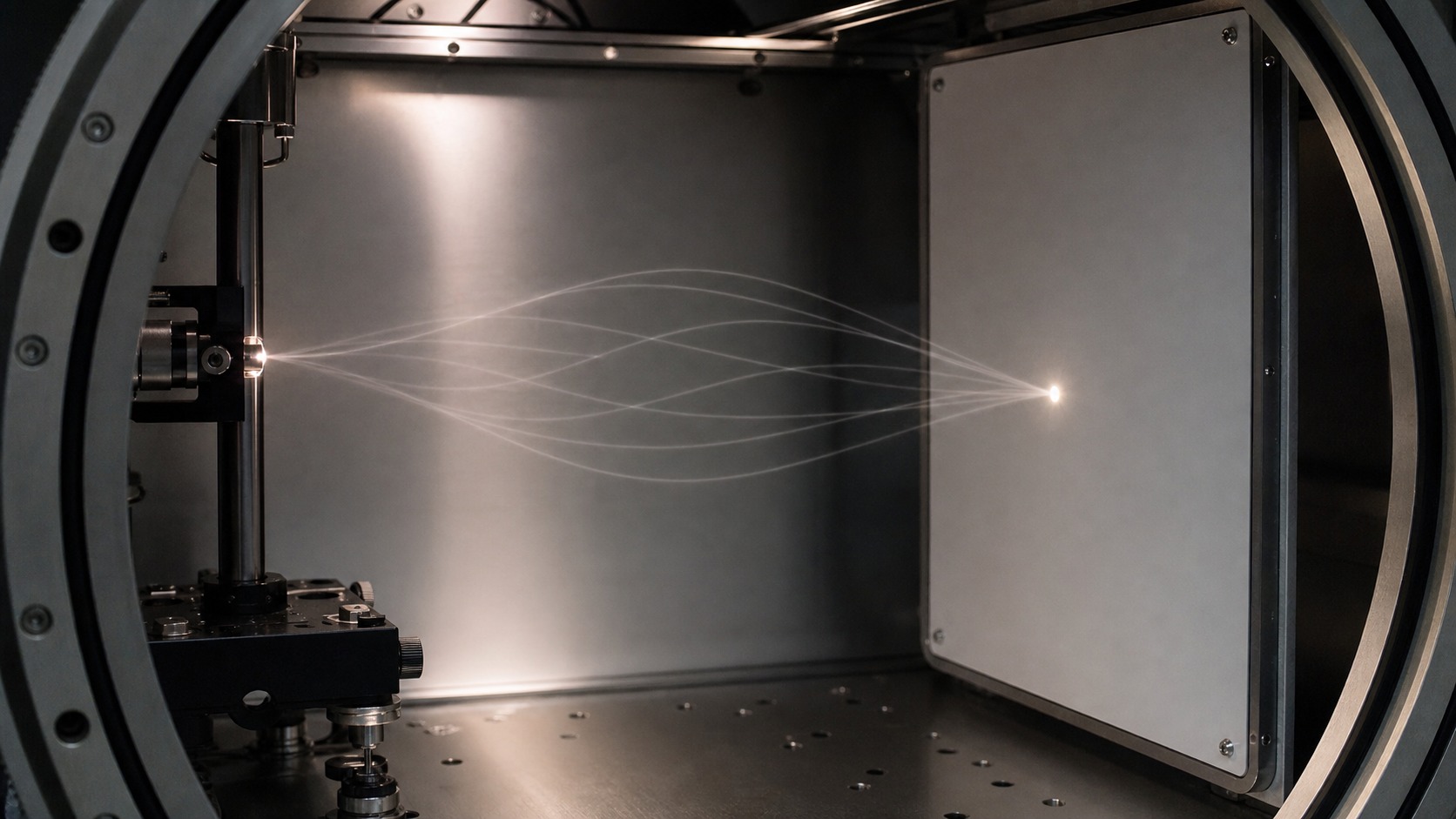
Images of quantum experiments often show equipment, detector patterns, or artistic overlays. They can be useful, but they should not be mistaken for photographs of superposition itself. A glowing path in an illustration is usually a teaching aid.
The real evidence may be a histogram, a fringe pattern, a correlation curve, or a reconstruction from many measurements. That evidence can be visually displayed, but the display is a representation of records.
What Counts as Observing Superposition
Observing superposition means observing consequences that require coherent alternatives. The standard is not whether a human eye catches the state directly. The standard is whether the experiment rules out simpler explanations and shows phase-sensitive behavior.
This is common in science. We observe atoms through instruments, gravitational waves through detector signals, and distant planets through changes in light. Direct sensory contact is not the only kind of observation.
For superposition, the strongest observations are controlled. Scientists prepare the state, vary a setting, and see whether the outcomes change in a way that depends on coherence.
Could Future Technology Change the Answer?
Future technology may make superposition effects easier to display, especially in larger engineered systems. Better isolation, colder devices, cleaner materials, and improved readout could make the evidence more vivid.
Still, the core limitation will remain. If seeing means creating a stable classical record, then seeing participates in measurement. The best future demonstrations may be clearer and larger, but they will still translate state behavior into records.
That is not a disappointment. It is part of what makes superposition quantum. The state is known through the patterns it can produce under carefully chosen questions.
Instruments also let researchers separate superposition from ordinary blur. A camera image might be ambiguous, but a controlled sequence with and without path information can reveal whether amplitudes were still coherent. That comparison is where the claim earns its force.
How to Talk About Seeing Carefully
A careful sentence is better than a dramatic one. Instead of saying humans can watch a particle be in two places, say that experiments reveal behavior consistent with coherent alternatives. That wording keeps the evidence impressive without making it cartoonish.
It also respects measurement. A detector record is not the same as the pre-measurement state. The record is what the state led to under one experimental question.
Good explanations can still be vivid. They just need to keep the difference between seeing a result and seeing the full state clear.
Why Directness Is Not the Scientific Standard
Science often relies on indirect observation. We infer atoms from tracks, spectra, scattering, and device behavior. We infer magnetic fields from forces and alignment. We infer distant planets from light changes. Direct eyesight is only one narrow form of evidence.
Superposition fits that broader pattern. The state is not seen as a visible object, but its consequences can be predicted, controlled, and reproduced. That is a strong kind of observation when the experiment is designed carefully.
The demand to see superposition with unaided eyes sets the wrong standard. It asks a fragile quantum relationship to survive the very interactions that ordinary seeing requires.
A better standard is controlled repeatability.
When a measurement becomes visible, it is already a record. The screen, sensor, or display has translated the quantum event into classical information. That visible result is valuable, but it is not the same thing as watching the unmeasured superposition itself.
How Images Should Be Interpreted
Popular articles often show glowing paths, split objects, or layered graphics. These images can help readers begin, but they are not evidence by themselves. They are visual summaries of a state description or experimental result.
When the image is a real laboratory photo, it usually shows the apparatus rather than the superposition. When it is an illustration, it usually makes an invisible relationship visible for teaching. Both can be useful if their roles are clear.
Why the Eye Is Too Noisy
The human eye is a warm biological detector. It works beautifully for daily life, but it is not built to preserve isolated quantum alternatives. Photons scatter, molecules change state, and neural records are amplified into classical information.
That does not make vision inferior. It makes vision the wrong tool for this exact job. Quantum experiments use specialized detectors because they can control the interaction and define the measurement more carefully.
Ordinary sight gives stable experience. Quantum apparatus gives controlled evidence.
What a Future Demonstration Might Show
A future demonstration may make the consequences of superposition easier to see on a screen. It might show a larger mechanical system, a cleaner interference pattern, or a more intuitive visualization of state reconstruction.
Even then, the display will be a record of measurements and analysis. The pre-measurement state will still be known through how the apparatus behaves, not by naked-eye inspection of the state itself.
That is not a weakness. It is how quantum evidence becomes public, stable, and checkable.
The most honest demonstration may be the one that shows both the pattern and the controls that make it disappear.
Why Evidence Can Be More Direct Than Vision
In physics, a measurement can be more trustworthy than unaided sight. Eyes are wonderful but limited. Instruments can isolate variables, repeat conditions, measure timing, and compare controls in ways human perception cannot.
Superposition is a perfect example. A person cannot stare at the full state, but an experiment can show how the state responds when phase, basis, path information, or environmental coupling is changed. Those responses are more informative than a simple picture would be.
The evidence is also shareable. Data can be checked by other laboratories, reanalyzed, and compared with predictions. A visible impression in one person’s experience would be far weaker than a repeatable pattern in controlled records.
This is why indirect does not mean second best. For superposition, indirect evidence is the correct kind of evidence.
The state is known by what it reliably makes happen.
Why The Best Evidence Is Usually Indirect
Indirect evidence can feel weaker in everyday argument, but physics often works the opposite way. A controlled signature tied to a prediction can be stronger than a picture that merely looks convincing. Superposition is usually established through that kind of signature.
Interference is the cleanest example. Nobody has to see both alternatives with the eye for the result to be meaningful. If removing path information restores a pattern and adding path information destroys it, the evidence is tightly connected to the quantum claim.
The same logic appears in qubits, atoms, and molecules. The state is known through how it responds, not through a literal photograph of possibility.
The Seeing Takeaway
Humans do not see superposition as an ordinary object suspended in front of the eyes.
We see its disciplined consequences through instruments, repeated trials, and patterns that only coherent quantum alternatives can produce.