The Tradeoff Behind The Famous Pair
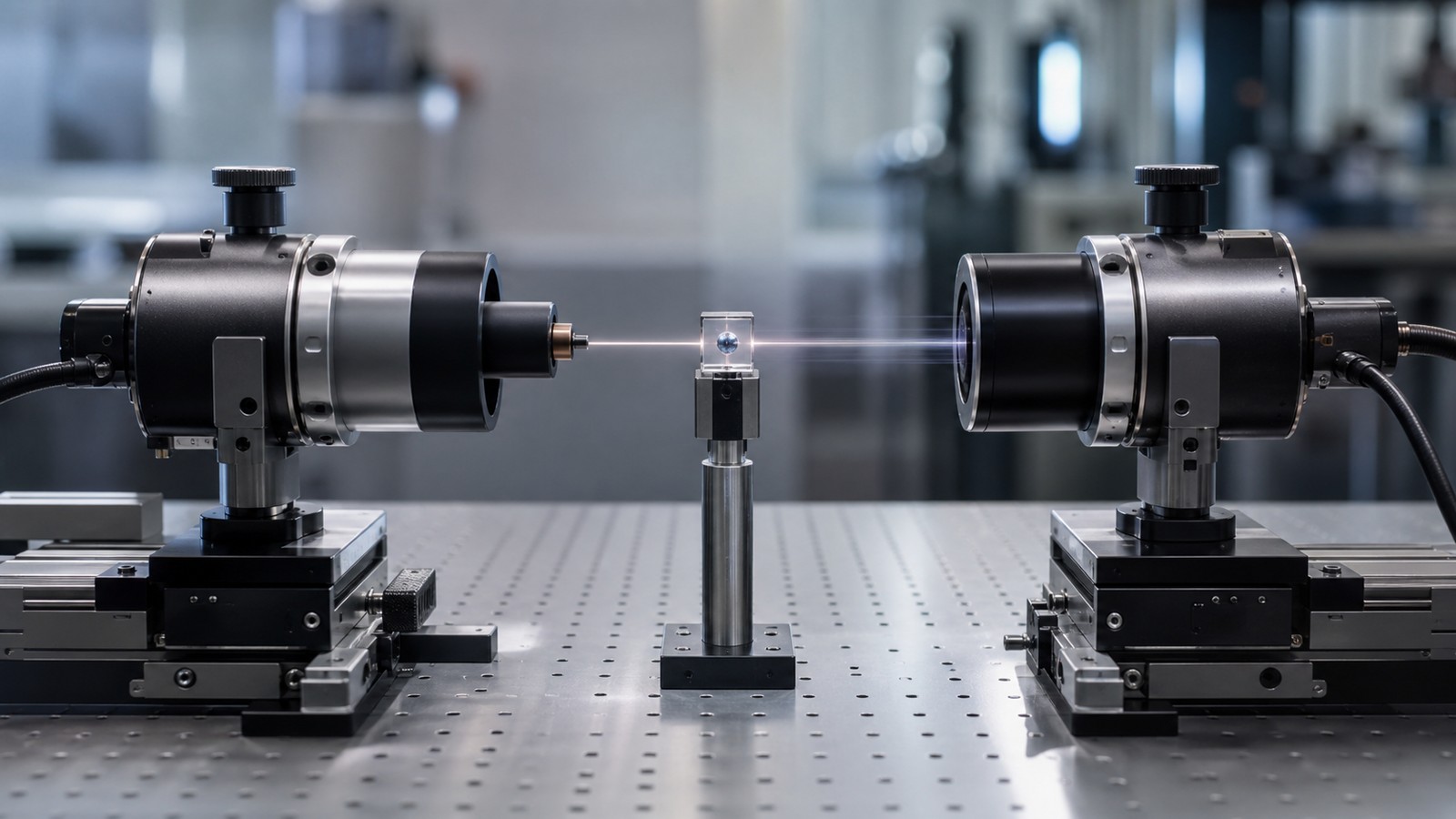
Position and momentum cannot be known together with unlimited precision because quantum states do not behave like tiny classical objects carrying every property in a hidden notebook. Position tells where a particle is found. Momentum tells how its motion is directed and scaled. Classical intuition expects both to exist sharply at the same time, whether or not anyone measures them. Quantum mechanics says the state cannot always support that expectation. If the state is compressed into a narrow region of space, its momentum possibilities spread out. If the state has a very well-defined momentum, its position must be spread over a wider region. This is not mainly a story about clumsy observation. It is a story about wave structure, preparation, and what kind of information a state can contain.
A: Position and momentum are linked through the wave structure of the state.
A: No detector can make one state hold both properties with unlimited sharpness.
A: A localized state needs a wider range of momentum components.
A: The state becomes more spread out in position.
A: Yes. Narrow openings create broader downstream momentum-related patterns.
A: No. Momentum includes direction and relates to spatial wave structure.
A: Yes. The principle limits unlimited simultaneous precision, not every approximate estimate.
A: The first measurement changes the state used for later predictions.
A: Yes. The state can be known precisely while incompatible properties remain spread.
A: The classical idea of exact tiny trajectories does not always apply.
What Position Means In A Quantum Experiment
Position sounds simple because everyday objects occupy familiar places. A phone is on a desk, a ball is on the floor, and a car is in a lane. Those statements work because ordinary objects constantly interact with their surroundings and maintain path-like records.
For a quantum particle, position is a possible measurement outcome. A detector may register the particle in one region, but the state before that detection can be spread across many possible locations. The spread is part of the prediction, not a camera blur.
A narrow position state is possible, but it comes with a cost. The more sharply the state is localized, the less sharply its momentum can be defined.
What Momentum Adds To The Picture
Momentum is not just speed. It includes direction and is connected to how the state changes across space. In wave language, a clean momentum corresponds to a state with a regular repeating structure.
That regular structure cannot be squeezed into a single tiny point without mixing in other momentum components. The attempt to sharpen position forces the state to include a wider range of possible momenta.
Why Wave Packets Explain The Tradeoff
A wave packet gives beginners a useful picture. To make a localized packet, many waves with different wavelengths have to be combined. Their overlap creates a concentrated region, but their different wavelengths imply a spread of momenta.
A nearly single-wavelength wave has a much cleaner momentum. Yet it extends broadly, so it does not identify one exact position. The state gains clarity in one property by giving up clarity in the other.
This is the physical heart of the position-momentum uncertainty relation. The tradeoff is not added after the fact. It is built into the wave-like representation of the state.
Why Measurement Cannot Outsmart It
A measurement device can be refined, but it cannot make a state contain incompatible sharpness that it does not have. A position measurement can produce a sharper position record, but the resulting state will generally have a broader momentum distribution afterward.
Likewise, a momentum-focused preparation can create a narrow momentum spread while leaving the particle delocalized. The experiment chooses what kind of sharpness it is asking the state to support.
How Diffraction Makes It Visible
Diffraction gives the tradeoff a visible experimental form. When a beam passes through a narrow opening, the particles become more localized across that opening. The outgoing directions then spread out more strongly.
That spread is not random mess from a bad slit. It is the momentum uncertainty revealed by the narrow position constraint. The narrower the opening, the broader the downstream pattern becomes.
This is why diffraction belongs in uncertainty discussions. It turns a mathematical relation into a physical pattern that can be measured.
Why Exact Knowledge Is The Wrong Goal
The phrase cannot be known together can sound like a challenge to build a better measuring machine. Quantum mechanics frames it differently. The problem is not a practical shortage of cleverness; it is a limit on simultaneous definiteness.
A state can still be known very well. Physicists can know its wavefunction, its probability distribution, and its expected behavior. What they cannot do is assign perfect position and perfect momentum to the same state in the classical sense.
What Happens After A Position Record
After a position measurement, the system has a new experimental history. The recorded position becomes part of what future predictions must respect. The state used for later calculations is no longer the same broad pre-measurement state.
That update is why measurement sequences matter. Asking for position first and momentum later is not equivalent to imagining that both exact answers were waiting unchanged. The first interaction shapes what the second can reveal.
Sequential measurements therefore need careful language. They produce records, but those records do not prove that all properties had exact prior values.
Why The Pair Is So Famous
Position and momentum are famous because they connect quantum theory to a familiar picture of motion. If tiny particles do not always carry exact positions and momenta together, then the classical idea of a tiny trajectory has limited reach.
The pair also appears across many systems. Electron beams, atoms, photons, molecules, and trapped particles all reveal versions of the same tradeoff when prepared and measured carefully.
How To Keep The Explanation Straight
The cleanest explanation starts with the state, then names the property being sharpened. If position is narrowed, momentum spread grows. If momentum is narrowed, position spread grows. The order keeps the idea from becoming vague.
It also helps to avoid saying that the particle simply has both values and we fail to read them. That picture may work for a hidden marble, but it does not match the quantum state description. The state itself carries the tradeoff.
Once that is clear, the famous relation stops being a puzzle about bad measurement and becomes a rule about quantum description.
Why Together Means In The Same State
The phrase known together needs care. It does not merely mean two people have failed to write down two numbers at the same moment. It means one quantum state cannot make both position and momentum arbitrarily sharp in the classical sense.
That distinction prevents a common mistake. The principle is not defeated by imagining faster cameras or cleverer notebooks. The restriction belongs to the state being prepared and measured, not to the speed of a human record keeper.
How A Wave Packet Shows The Link
A wave packet gives a useful picture because it can be localized only by combining many wave components. Those components correspond to a spread of momenta. The more tightly the packet is squeezed in position, the wider the momentum mixture has to become.
A nearly single-momentum wave has the opposite behavior. It extends broadly, because a clean wavelength does not point to one sharply confined location. This is not an added mystery. It is a feature of wave structure.
Quantum mechanics turns that wave fact into a rule about possible measurement outcomes. Position and momentum are linked because the state cannot satisfy both classical demands without changing its own structure.
Why Measurement Disturbance Is Only Part
It is true that a sharp position measurement can disturb momentum. A photon, field, or detector interaction may change the system while producing a record. That practical story is useful in many laboratory examples.
Still, the uncertainty relation runs deeper than that disturbance picture. Even before a particular position detector is blamed, a state with narrow position spread carries broad momentum content. The tradeoff is already present in the description.
How Scientists Work With The Pair
Scientists do not treat the position-momentum limit as a reason to stop measuring. They decide which property needs priority. A beamline may emphasize momentum selection. A localization experiment may accept momentum spread. A diffraction experiment may deliberately turn spatial confinement into angular spread.
Those choices are practical. The principle becomes a design rule rather than a wall. A good apparatus does not pretend to beat the tradeoff; it uses the tradeoff to predict what will be seen.
This is why the pair appears in both foundation discussions and ordinary experimental planning. It is conceptually deep and technically useful.
Why The Pair Changed Physics
Position and momentum changed physics because they exposed the failure of a fully classical inventory. A particle is not always a small object carrying a perfectly sharp location and a perfectly sharp motion underneath every experiment.
How Localization Creates Spread
Imagine trying to make a particle’s position more definite by forcing its wave packet into a smaller region. The resulting packet cannot be built from one clean momentum component. It needs many components, and that mixture shows up as a wider range of possible momentum measurements.
This is why the relationship is not arbitrary. Position sharpness and momentum spread are connected through the structure of waves. Quantum mechanics gives that structure physical meaning for particles.
Why Momentum Is Not Just Speed
Momentum is sometimes treated as a fancier word for speed, but it includes mass and direction as well. In quantum mechanics, momentum is tied to wavelength and wave behavior. That is why the position-momentum pair is so naturally linked.
A clean momentum state behaves like a broad wave with a well-defined wavelength. A sharply confined state needs many wavelengths working together. The tradeoff follows from trying to demand both images at once.
For beginners, this connection is more useful than memorizing the principle as a slogan. It gives the limitation a reason.
How The Pair Shapes Real Beams
Particle beams in laboratories are never described only by a perfect line. They have spreads in position, angle, and momentum. Beam designers account for those spreads when focusing particles, sending them through apertures, or interpreting detector patterns.
The uncertainty principle sets a background boundary for those designs. Ordinary engineering errors can still be improved, but the wave-state tradeoff remains part of the ideal behavior.
What The Pair Does Not Forbid
The principle does not forbid useful approximate knowledge. Scientists can know position and momentum well enough for many purposes. What it forbids is unlimited simultaneous exactness.
Why Approximation Still Works
In many real situations, the spreads are small enough that approximate position and momentum are useful. Physicists can still aim beams, model atoms, and design instruments. The uncertainty principle does not destroy practical description.
It only blocks the final classical fantasy of infinite simultaneous sharpness. Approximate knowledge remains powerful because the relevant spreads can be calculated, controlled, and matched to the problem.
The Cleanest Beginner Test
Ask whether the explanation is about a prepared state or only about a rough measuring tool. If it is only about rough tools, it has not reached the real position-momentum principle.
How To Keep The Pair Straight
Start with the prepared state, not with a hidden moving bead. The state determines the spread of possible position records and momentum records. The two spreads are linked by the quantum description.
Then ask which measurement the experiment performs first. A position-focused apparatus and a momentum-focused apparatus create different later prediction problems. The order and context are not decorative details.
Finally, remember that useful approximate values are allowed. The forbidden dream is perfect joint sharpness, not every practical estimate.
The Position-Momentum Takeaway
Position and momentum cannot both be perfectly sharp because quantum states have wave-like structure.
The tradeoff limits classical trajectory thinking while still allowing precise probability-based prediction.