The Particles That Let Fields Act
Bosons are integer-spin particles whose quantum statistics allow many identical members to occupy the same state. Several elementary bosons also carry the interactions of the Standard Model: photons transmit electromagnetism, gluons bind quarks through the strong interaction, and W and Z bosons govern weak processes. The Higgs boson belongs to the same statistical family but plays a different role as an excitation of the Higgs field. A complete guide therefore needs two ideas at once: what makes any particle a boson, and why a special subset called gauge bosons appears as the messenger particles of fundamental forces. Keeping those ideas separate prevents several common misconceptions and makes the field-based explanation easier for new readers to follow from the very beginning.
A: Gauge fields have integer-spin quanta whose exchange rules are bosonic.
A: Not conventionally; it is the excitation of the mass-related Higgs field.
A: Quantum chromodynamics contains eight independent gluon color states.
A: Its W and Z carriers are extremely massive.
A: Indirect quantum effects permit it, although ordinary interactions are tiny.
A: No. Gluons hadronize into jets before detection.
A: No confirmed particle does; the graviton remains hypothetical.
A: Electroweak symmetry produces charged W-plus and W-minus field combinations.
A: No. W, Z, Higgs, and many composite bosons are massive.
A: Treat it as shorthand for interactions between coupled quantum fields.
What Makes a Particle a Boson?
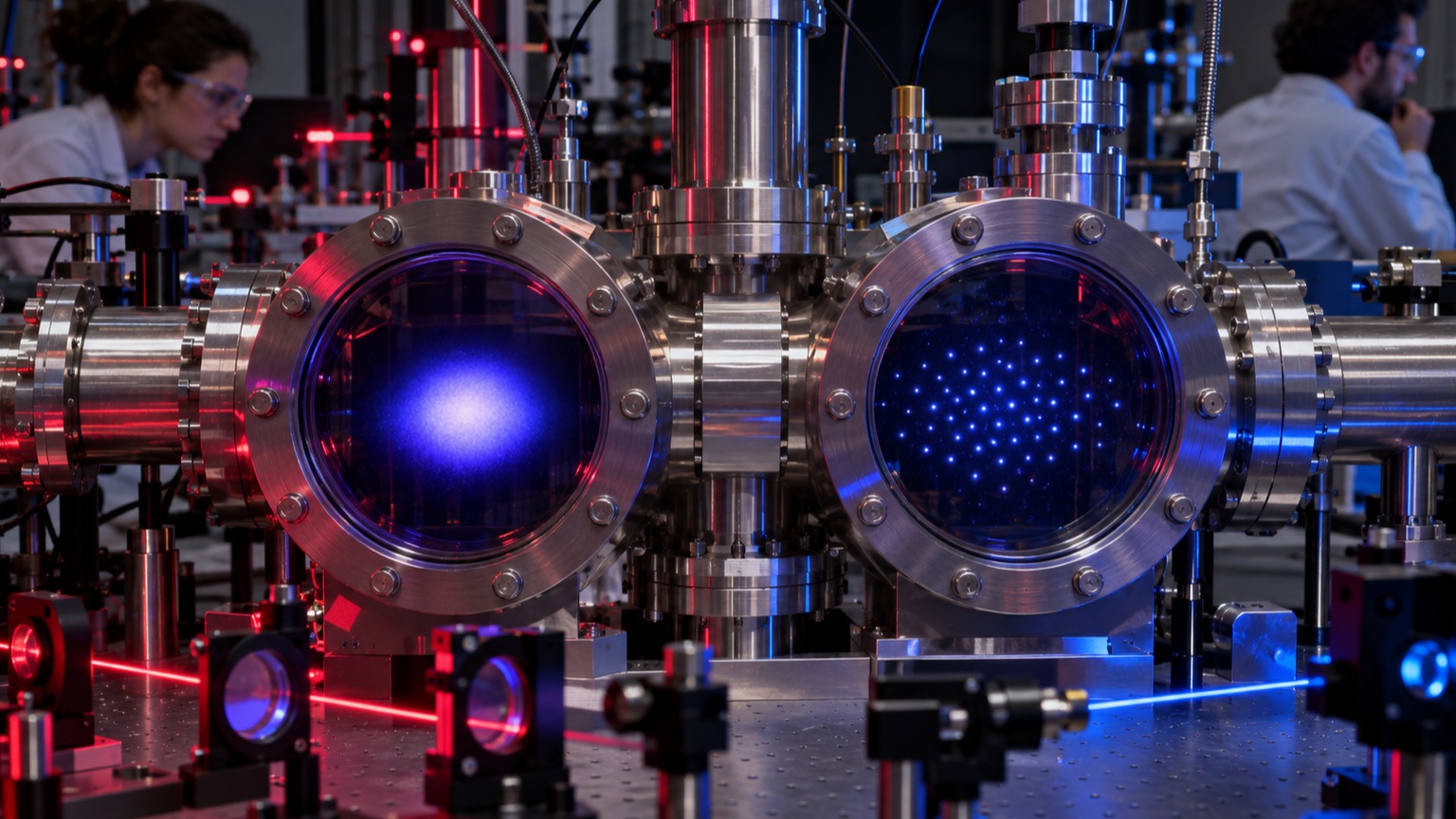
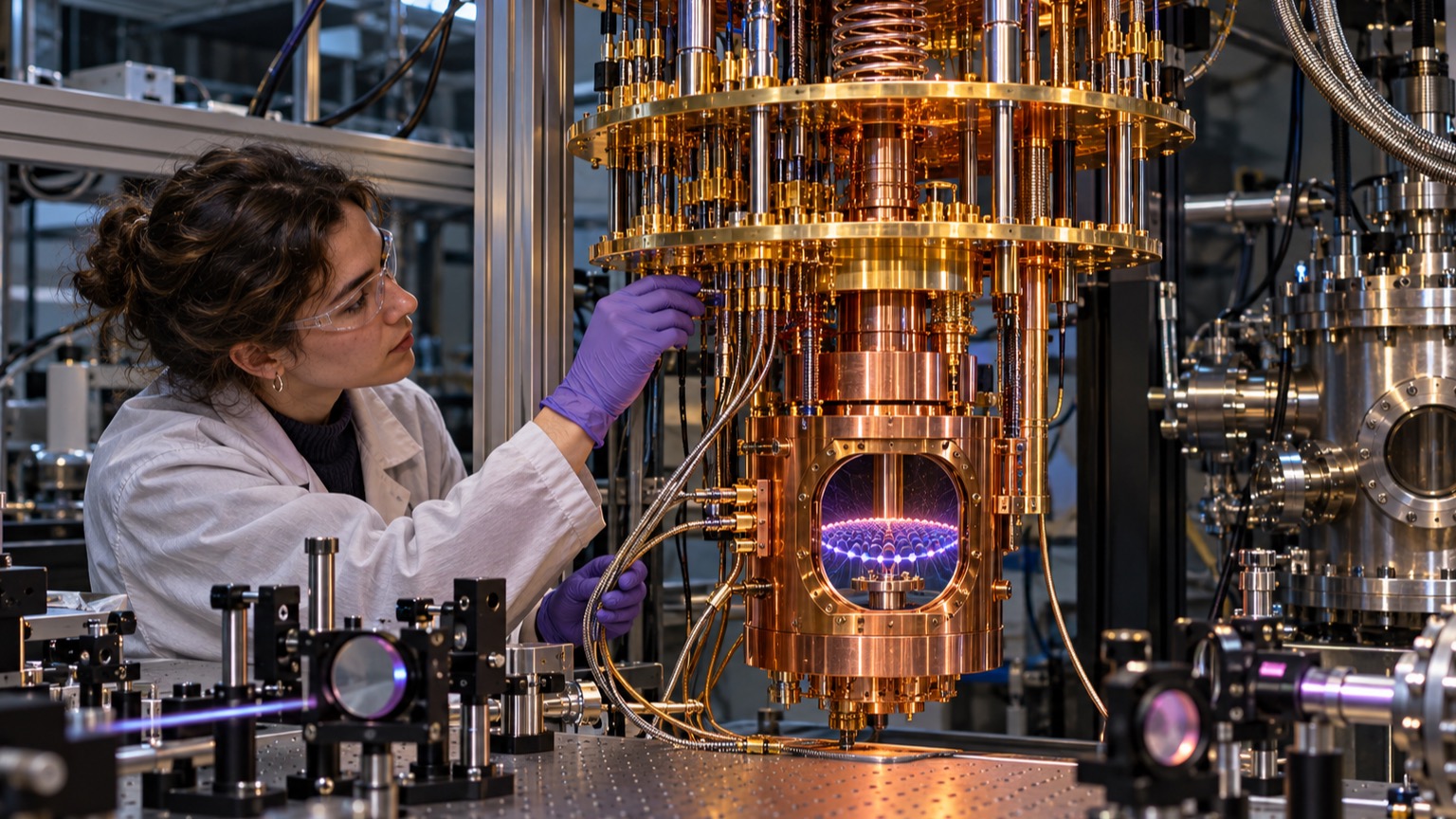
A boson has integer spin: zero, one, two, and so on in units of reduced Planck’s constant. Its many-particle quantum state is symmetric when two identical bosons are exchanged. Consequently, identical bosons are allowed to occupy the same quantum state. Photons can build a highly populated laser mode, and ultracold bosonic atoms can collect into a Bose-Einstein condensate.
The name honors physicist Satyendra Nath Bose, whose statistical work with photons led Einstein to generalize the idea to material particles. Boson is a category of quantum statistics, not a synonym for force carrier. Composite particles with integer total spin can behave as bosons, while the elementary Higgs is a boson without being a gauge boson.
Fields Come First in the Modern Description
Popular explanations say particles exchange messenger particles to exert forces. That image is useful if handled carefully, but quantum field theory starts with interacting fields. A photon is a quantum excitation of the electromagnetic field; a gluon is an excitation of the color gauge field. Interaction terms in the theory determine how those fields couple to matter and to one another.
Virtual particles that appear in calculation diagrams are not tiny projectiles secretly observed in transit. They are internal elements of a perturbative mathematical expansion and need not satisfy the same energy-momentum relationship as detectable particles. Real photons, gluons manifested through jets, and W or Z bosons reconstructed from decays are observable excitations. Keeping the distinction prevents a helpful metaphor from turning into a false mechanical story.
Gauge symmetry organizes these interactions by limiting which field couplings are allowed. The symmetry is not merely visual balance; it is a freedom in the mathematical description that must leave observable predictions unchanged. Requiring that consistency introduces gauge fields and fixes much of their structure.
The Photon Carries Electromagnetism
The photon is massless, electrically neutral, and spin one. It couples to electrically charged particles and underlies light, radio waves, X-rays, chemical bonding, electricity, magnetism, and the electromagnetic forces between atoms. Because the photon is massless, the electromagnetic interaction has an infinite theoretical range, although charges in matter can screen fields.
Photons themselves carry no electric charge, so the electromagnetic field lacks the same kind of strong self-coupling seen among gluons. Quantum electrodynamics nevertheless allows photons to influence one another indirectly through fluctuations involving charged particles. Those effects are tiny under ordinary conditions but measurable in sufficiently intense or precise experiments.
A real photon’s energy depends on frequency. High-frequency photons carry more energy than low-frequency photons, while changing intensity usually changes how many photons arrive. That quantum relation explains the photoelectric effect and connects the force carrier of electromagnetism with the particles of light detected by cameras and telescopes.
Photons also possess polarization, which records the orientation of their field oscillation and supplies a quantum degree of freedom. Polarization enables technologies from glare-reducing optics to quantum communication experiments. It also gives particle physicists another observable for testing production mechanisms.
Gluons Bind Quarks
Eight gluon states mediate the strong interaction described by quantum chromodynamics. Gluons are massless spin-one bosons and carry color charge, unlike electrically neutral photons. Because they carry the charge of their own interaction, gluons couple to one another. This nonlinearity produces the distinctive scale dependence of the strong force.
At very short distances, the effective coupling becomes weaker, allowing high-energy processes to be calculated using expansions. At larger distances, the interaction strengthens and confines quarks and gluons inside color-neutral hadrons. A gluon knocked into a high-energy state does not fly to a detector alone. It initiates a cascade and hadronizes into a jet whose shape and particle content reveal the original process statistically.
Gluon fields contribute most of the mass of protons and neutrons through their energy and the dynamics of confined quarks. The particles carrying the strong interaction therefore do more than hold preexisting masses together; their field energy helps create the mass scale of ordinary visible matter.
W and Z Bosons Carry the Weak Interaction
The W-plus, W-minus, and Z bosons are massive spin-one gauge bosons. Their large masses make weak interactions extremely short-ranged. W bosons carry electric charge and can change particle flavor. In beta decay, the underlying quark transition involves a W boson, while the final products include an electron and an antineutrino. The Z boson is neutral and mediates weak processes in which electric charge does not change.
Although weak reactions are rare compared with electromagnetic ones at everyday energies, they are essential. They allow the Sun’s fusion chain to begin, drive several types of radioactivity, shape neutrino interactions, and influenced the balance of particles in the early universe. Neutrinos, which ignore the strong force and carry no electric charge, can still interact through W and Z bosons.
Electromagnetism and the weak interaction are two aspects of an electroweak theory. At low energies they look very different because the Higgs field leaves the photon massless while W and Z bosons become heavy. At sufficiently high energies, their underlying relationship becomes clearer.
The weak interaction also violates several symmetries that other familiar processes respect. It distinguishes left-handed from right-handed particle states and permits flavor mixing among quarks. Those features make W and Z measurements sensitive probes of the Standard Model’s deepest structure.
The Higgs Boson Has a Different Assignment
The Higgs boson is a spin-zero excitation of the Higgs field. It does not carry a conventional force between charges in the way a photon or gluon does. Instead, the field’s nonzero value throughout space changes the electroweak theory’s ground state. W and Z bosons acquire mass through their interaction with it, and quarks and charged leptons acquire masses through their own Higgs couplings.
Particles that couple more strongly to the Higgs field have larger elementary masses, but the pattern of coupling strengths remains unexplained within the Standard Model. Neutrino mass requires additional treatment beyond the model’s simplest original version. The Higgs mechanism also should not be credited with all macroscopic mass: QCD energy inside nucleons provides most of the mass in ordinary objects.
Why Force Range Relates to Carrier Mass
Massless photons allow electromagnetic influence to extend indefinitely, with strength falling as distance increases. Massive W and Z bosons produce a weak interaction that falls off extremely rapidly and is effective only at subatomic distances. The strong interaction is more subtle: gluons are massless, but color confinement prevents a simple long-range force between isolated color charges. Residual strong forces between color-neutral nucleons remain short-ranged.
The relationship is best understood through the field’s propagator and quantum dynamics, not as a massive messenger becoming tired. Carrier mass changes how amplitudes decrease with distance. Self-interaction and confinement can transform the picture further, as QCD demonstrates.
Range also differs from strength. A short-ranged interaction can be important whenever particles approach closely enough, and a long-ranged interaction may be weak between individual particles yet dominate large systems because its effects accumulate. Labels such as strong and weak describe measured coupling behavior in specified regimes, not a universal ranking at every energy.
Where Is the Boson for Gravity?
A hypothetical graviton would be a massless spin-two boson in many quantum descriptions of gravity. No graviton has been detected, and the Standard Model does not include gravity. General relativity describes gravity as the geometry of spacetime with exceptional success, while quantum theory describes the other interactions. Reconciling the two remains a central open problem.
Calling the graviton “the gravity particle” should therefore come with a clear label: it is a theoretically motivated possibility, not a confirmed member of the particle inventory. Direct detection would be extraordinarily difficult because individual quantum gravitational interactions are so weak.
How Bosons Appear in Detectors
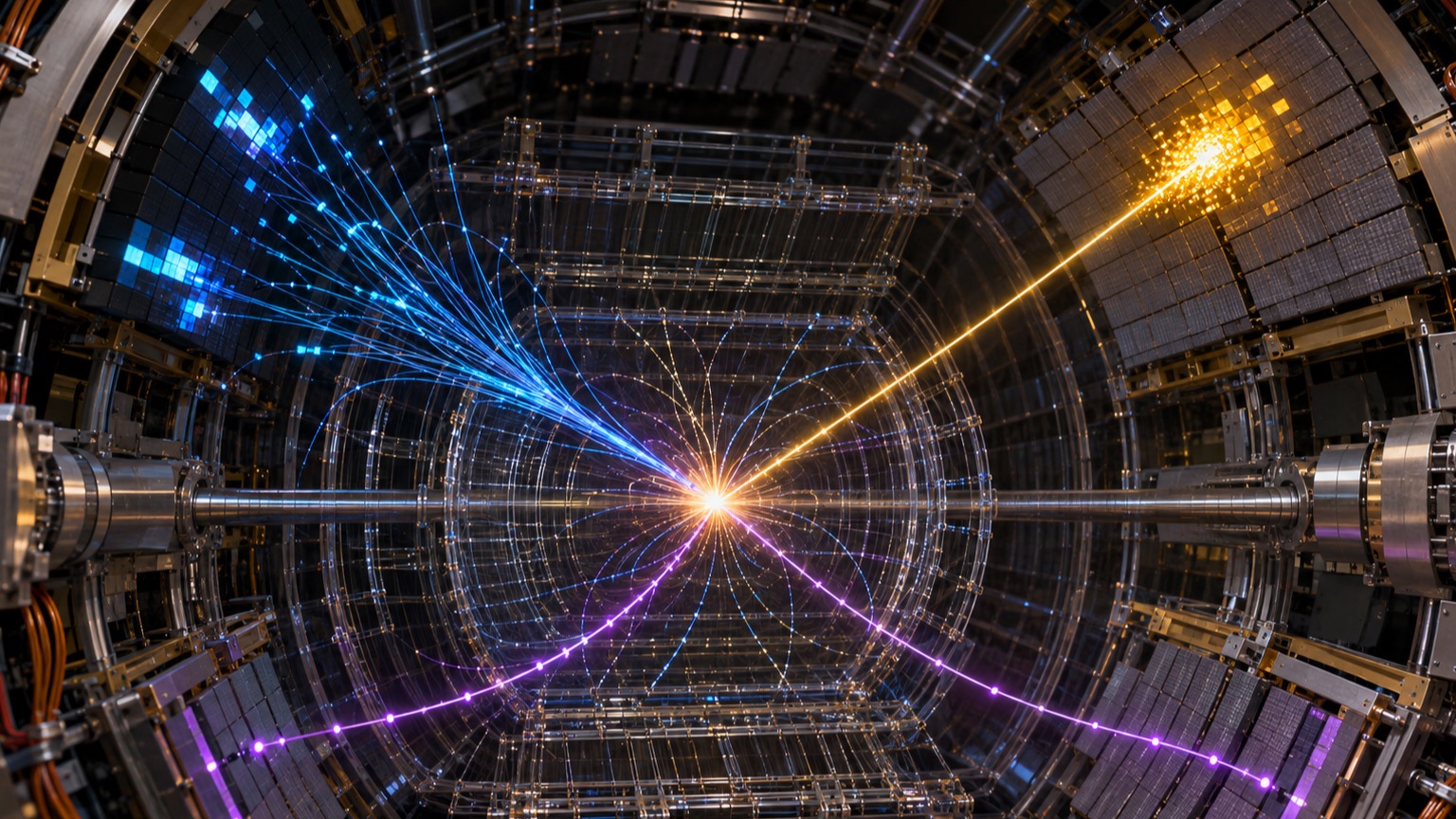
Stable photons deposit energy in electromagnetic calorimeters or convert into charged particle pairs. Gluons are inferred from jets. W bosons decay almost immediately, often producing a charged lepton and an unseen neutrino; missing transverse momentum helps reconstruct the event. Z bosons can decay into pairs of electrons or muons, leaving especially clean signatures whose combined energy and momentum reveal the Z mass.
The Higgs also decays too quickly to travel through a detector. Experiments identify it by combining many events in channels such as two photons, four charged leptons, or heavy-quark products and finding a consistent excess at one mass. Discovery does not require a long-lived particle track. It requires statistically persuasive, cross-checked patterns among decay products.
Background modeling is therefore central. Ordinary Standard Model processes can imitate the same final particles, so analysts predict their rates, calibrate detector response, and test control samples. A new boson claim becomes convincing only when one consistent hypothesis explains the excess across data sets and survives alternative checks.
Bosons Beyond Fundamental Messengers
Helium-4 atoms, certain atomic isotopes, mesons, and paired electrons can act as composite bosons when treated as intact units. Their shared statistics enable superfluidity, atomic condensation, and superconducting coherence. Quasiparticles in materials can also have bosonic character, including collective vibrations called phonons and quantized spin waves called magnons.
These examples broaden the concept without expanding the list of elementary fields. A phonon is not a fundamental particle roaming empty space; it is a quantized collective excitation of a material. The same bosonic mathematics can govern both fundamental quanta and emergent excitations because exchange symmetry and occupation rules depend on the effective quantum object.
A Better Mental Model for Force Carriers
Think of matter particles and bosons as excitations of coupled fields governed by precise symmetries. Charges specify how a matter field responds to a gauge field. The boson is the detectable quantum of that gauge field, while interactions and virtual effects arise from the full field theory. This view handles creation, annihilation, interference, and particle transformations more accurately than an image of objects tossing balls.
The central inventory is still easy to remember: photon for electromagnetism, eight gluons for the strong interaction, and W-plus, W-minus, and Z for the weak interaction. Add the Higgs as the spin-zero excitation tied to electroweak symmetry breaking. Leave the graviton in the hypothetical column. That framework is simple enough for a beginner and strong enough to support deeper study.
Beyond memorization, the inventory demonstrates how symmetry, field content, and observation meet. Each boson’s spin, mass, charge, coupling, and decay pattern belongs to one coherent theory. Precision experiments keep testing that coherence because even a small mismatch could reveal an additional field or interaction beyond the current model.