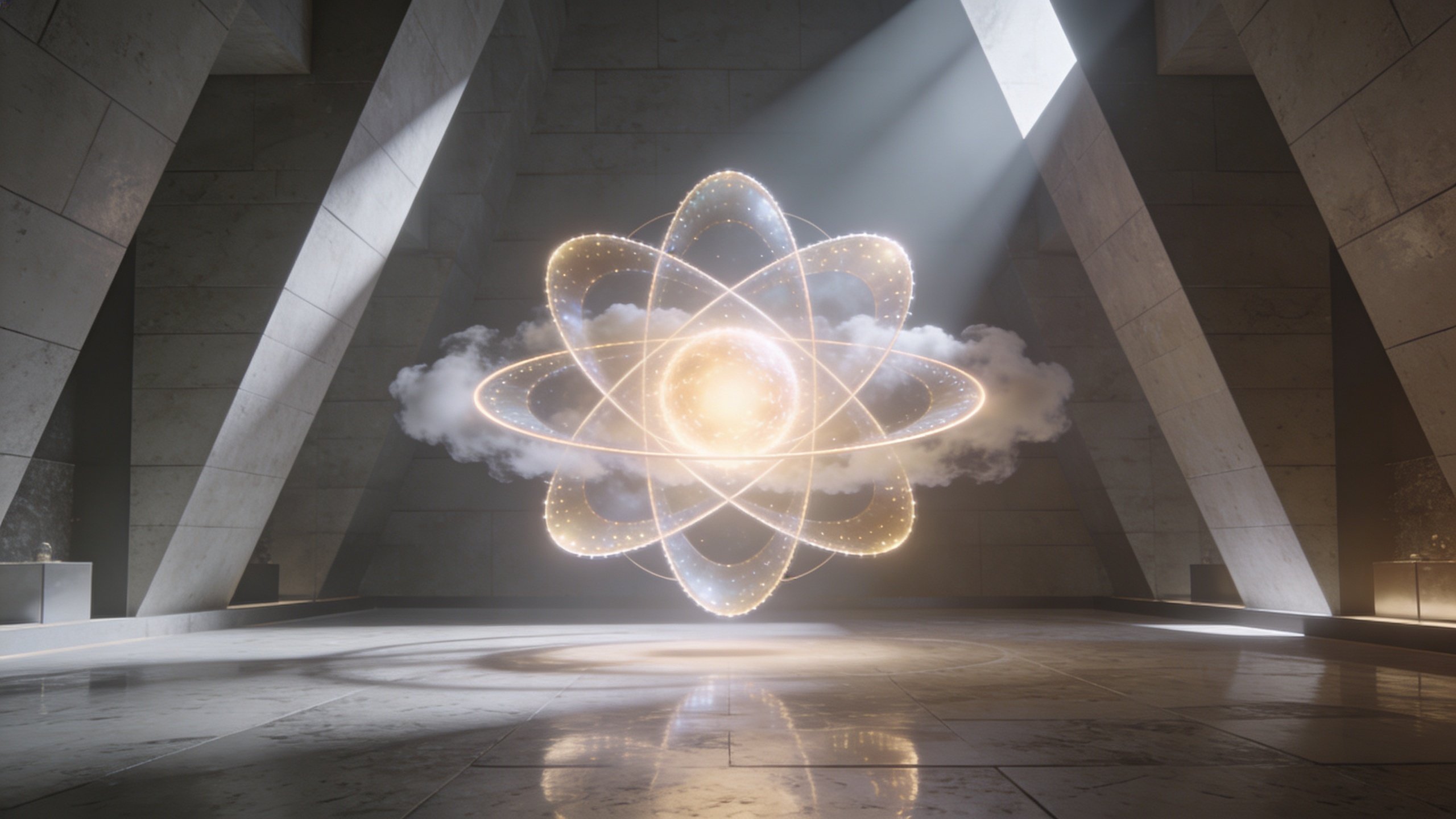
The Strange Moment Physics Became Personal
Quantum collapse sounds like something dramatic, distant, and abstract, but at its heart it asks a deeply human question: what happens when we look at the world closely enough? In everyday life, observation feels passive. You look at a tree, a car, or a cup of coffee, and you assume those things stay exactly what they were whether you look or not. In the quantum world, that certainty begins to crack. At the scale of particles, observation is not always a neutral act. Measuring something can change it, and that idea has fascinated scientists, philosophers, and curious readers for more than a century. When people hear the phrase “when you observe a particle,” they often imagine a human eye peering into a microscopic realm and somehow forcing matter to behave. The real story is subtler and much more interesting. In quantum physics, observation does not mean simply watching with your eyes. It means interacting with a system in a way that reveals information. That interaction can disturb the system, and in some interpretations of physics, it causes what is called wave function collapse. This is the point where a particle that seemed to exist in many possible states suddenly appears in one definite state.
A: It is the idea that a particle with many possible states gives one definite result when measured.
A: Usually no; physicists usually mean physical interaction or measurement, not human thought alone.
A: It means measuring a system or interacting with it in a way that reveals information.
A: Because the measurement tool interacts with the particle and can disturb its delicate quantum state.
A: It can show features of both, depending on how the experiment is set up.
A: It means a quantum system can exist in multiple possible states before measurement.
A: It is a famous test showing that particles can act like waves until path information is measured.
A: It is a scientific theory, which means it is a powerful, heavily tested explanation backed by experiments.
A: Yes, but large objects interact with their environment so much that quantum effects are harder to notice.
A: Quantum physics explains part of how reality works and powers technologies already used in modern life.
Why Quantum Physics Feels So Different from Everyday Life
The reason quantum mechanics feels so strange is that it does not behave according to our ordinary instincts. In the visible world, objects usually have clear positions, clear speeds, and predictable paths. A baseball travels through the air in a way that seems solid and reliable. If you know enough about the throw, you can estimate where it will land. But tiny particles like electrons and photons do not always play by those rules. Instead of acting like tiny billiard balls, they often behave like waves of possibility. That is where the confusion starts for many people. A particle can be described as spread out over several possible locations or conditions at once until something forces a definite result. This is not because scientists are bad at measuring. It is built into the mathematics of quantum mechanics itself. Instead of saying, “the particle is here,” the theory often says, “the particle has a certain chance of being found here.” Observation then turns those chances into one actual outcome. That leap from possibility to reality is what people mean by quantum collapse.
What Scientists Mean by a Particle’s “Wave Function”
To understand collapse, it helps to understand the wave function. The wave function is a mathematical description of all the possible states a quantum object can have. It does not look like a water wave or a sound wave in any simple visual sense, but it behaves like a map of probabilities. It tells physicists the likelihood of where a particle might be found, how fast it might be moving, or what energy it might have when measured.
Before a measurement, the wave function can include several possible outcomes at once. This is called superposition. Think of it as a list of allowed possibilities that coexist in the math, even though we do not see them all at once in daily life. Once a measurement happens, only one result is observed. If an electron could have shown up in several places, the act of measurement reveals just one of them. The wave function appears to collapse from many possibilities down to one observed fact.
Superposition: The Heart of Quantum Weirdness
Superposition is one of the most famous and misunderstood ideas in science. It does not mean that a particle is lazily undecided. It means the particle is described by a combination of possible states until an interaction singles out one result. This is deeply unlike ordinary objects. A coin on a table is either heads or tails even before you look. In quantum theory, a particle can be in a blend of possibilities that only becomes specific when measured. This is why quantum experiments seem so surprising. A particle is not always sitting quietly in one state waiting for us to discover it. Instead, the theory suggests that reality at that scale is described in terms of potential outcomes. The particle has a structured range of possibilities, and observation reveals one of them. That does not mean the observer creates reality out of nothing. It means the quantum system and the measurement process are linked in a way that classical physics never prepared us for.
What Does “Observation” Really Mean in Quantum Physics?
One of the biggest myths in popular science is that human consciousness causes particles to collapse simply by looking at them. That makes for dramatic headlines, but it is not how most physicists describe the process. In science, observation usually means measurement, and measurement means interaction. A detector, a photon, a magnetic field, or another particle can serve as the thing that “observes” the system by interacting with it and recording information.
That point matters because it brings quantum collapse out of the mystical and back into the physical. A particle does not need a human mind staring at it. It needs some kind of contact with the environment or measuring device that makes one outcome physically real in a recordable way. In many cases, the measuring setup itself changes the system so much that the previous spread of possibilities no longer survives. That is why physicists often say that information and interaction lie at the center of the mystery.
The Double-Slit Experiment and the Power of Measurement
No experiment explains quantum collapse better than the double-slit experiment. Imagine firing tiny particles, such as electrons or photons, at a barrier with two narrow openings. If the particles behaved like little pellets, you would expect them to go through one slit or the other and form two neat bands on a screen behind the barrier. But when no which-path measurement is made, the particles produce an interference pattern, the kind of pattern waves make when they overlap.
This result suggests that each particle behaves like a wave of possibilities traveling through both slits at once. But when scientists set up a detector to learn which slit the particle actually goes through, the interference pattern disappears. Instead, the particles behave more like localized objects. That change is one of the clearest examples of how measurement alters the result. The system that once displayed wave-like behavior now gives a more definite particle-like outcome because the act of extracting information changes what is possible.
Does the Particle “Know” You Are Watching?
This question comes up often because the language around quantum observation sounds almost alive. It is tempting to ask whether the particle somehow senses attention. But the better way to think about it is in terms of physical relationships. The particle does not care that a scientist is curious. What matters is whether the experimental setup allows the particle to remain in a delicate superposition or whether it forces the system into a measurable state by interacting with it.
In other words, the particle is not responding to awareness. It is responding to contact, disturbance, and the transfer of information. If a detector scatters light off a particle to find out where it is, that light changes the particle’s behavior. The very tools used to gain certainty introduce new conditions into the experiment. Quantum systems are sensitive enough that those conditions matter enormously. So the particle does not “know” it is being watched, but the physical act of watching changes what can happen.
Why Measurement Disturbs the Quantum World
To measure something tiny, you usually have to hit it with something else. That creates a problem. If you want to locate an electron, for example, you might use light. But light comes in packets called photons, and when a photon interacts with an electron, it can change the electron’s momentum or position. The measurement gives you information, but it also disturbs the thing you are trying to understand. This is closely related to the uncertainty principle, another famous idea in quantum mechanics. The uncertainty principle says there are limits to how precisely certain pairs of properties, such as position and momentum, can be known at the same time. This is not just a flaw in our equipment. It reflects how nature behaves at very small scales. The more sharply you pin down one property, the fuzzier the other becomes. Quantum collapse fits into this picture because measurement is never separate from the system being measured.
Wave Function Collapse: A Real Event or a Useful Rule?
Scientists agree that quantum mechanics predicts experimental results extremely well. What they do not all agree on is what collapse really means. Some physicists treat wave function collapse as a real physical event. In that view, the wave of possibilities genuinely reduces to one actual state during measurement. Other physicists think collapse is better understood as an update in our knowledge. According to that approach, the wave function tells us what we can predict, and measurement changes the information we have rather than forcing nature to jump in some literal way.
This disagreement is one reason quantum theory still inspires debate. The math works, but the meaning is still being explored. Different interpretations of quantum mechanics try to explain this transition from many possibilities to one result. The Copenhagen interpretation, many-worlds interpretation, decoherence theory, and several other frameworks all try to answer the same basic puzzle. They do not always agree on what collapse is, but they all wrestle with the same extraordinary fact: the quantum world behaves as though possibility and reality are connected through measurement.
Decoherence: How the Environment Pushes Quantum Systems Toward Reality
A powerful modern idea related to collapse is decoherence. Decoherence helps explain why quantum weirdness is easy to see in tiny particles but hard to see in large objects like cats, chairs, or planets. In the real world, systems constantly interact with their surroundings. They bump into air molecules, absorb heat, emit radiation, and exchange information with the environment. These countless interactions quickly destroy the delicate relationships that make superposition visible.
When decoherence happens, the system starts behaving more classically. The spread of quantum possibilities becomes effectively unavailable for observation because the environment has already “measured” the system in a loose but powerful way. This does not solve every philosophical question about collapse, but it explains why the large world seems stable and ordinary. Quantum possibilities are not absent at larger scales. They are just overwhelmed by constant interaction. Decoherence is one of the key reasons the everyday world does not look like a science fiction movie.
Schrödinger’s Cat and the Problem of the In-Between
Perhaps no image captures the mystery of quantum collapse better than Schrödinger’s cat. This thought experiment was created to show how odd quantum ideas become when extended into ordinary life. In the story, a cat in a sealed box is linked to a quantum event that may or may not trigger a deadly mechanism. Before the box is opened, the cat is sometimes described as both alive and dead in a quantum superposition.
Most people react to this with disbelief, and that reaction is exactly the point. Schrödinger wanted to show how strange it is to take the math of superposition and apply it to familiar objects. The thought experiment forces us to ask where quantum uncertainty ends and definite reality begins. Does the cat become one thing only when someone opens the box? Or did interaction with the mechanism and environment already settle the outcome long before? Schrödinger’s cat remains famous because it turns an abstract problem into a vivid mental picture.
What Quantum Collapse Does Not Mean
It is easy to let imagination run wild with quantum ideas, but some popular claims go far beyond what the science supports. Quantum collapse does not mean your thoughts directly reshape reality however you want. It does not prove that consciousness controls the universe in a magical sense. It does not mean the world only exists when people pay attention to it. These ideas are dramatic, but they mix scientific language with claims that physics itself does not clearly make.
What quantum mechanics does show is that at very small scales, measurement and reality are more intertwined than common sense would suggest. The act of gaining information cannot always be separated from the behavior of the system. That is already strange enough without adding unsupported conclusions. The beauty of quantum physics is not that it confirms every mystical idea. It is that the actual science is genuinely surprising, even when kept within careful, evidence-based boundaries.
Why This Matters Beyond the Physics Lab
Quantum collapse may sound like a topic reserved for textbooks and laboratories, but it has real importance in modern science and technology. Understanding quantum measurement is essential for building quantum computers, designing ultra-sensitive sensors, and creating secure communication systems. Engineers working on quantum technologies must learn how to preserve delicate superpositions when they are useful and how to measure them when results are needed. The question of observation is also central to some of the biggest scientific and philosophical discussions of our time. It touches on the nature of reality, the limits of knowledge, and the relationship between mathematics and the physical world. Even for people who never step into a physics lab, quantum collapse offers something powerful: a reminder that nature is deeper and stranger than our everyday habits of thought. It shows us that certainty is sometimes not a built-in feature of the world, but something that emerges through interaction.
The Lasting Mystery of Watching the Smallest Things
So what happens when you observe a particle? According to quantum theory, a system described by many possible outcomes gives one definite result when measured. The wave function appears to collapse, or at least our description of the system changes sharply from possibility to outcome. The exact meaning of that transition is still debated, but the experimental fact remains: measurement matters. Observation is not just passive watching. It is a physical event with consequences. That is what makes quantum collapse such a lasting source of fascination. It sits at the edge of science, philosophy, and imagination. It challenges the idea that the world is always fixed and fully defined before we interact with it. It asks us to rethink what it means to know something, to measure something, and to call something real. For non-scientists, that may be the most exciting part of all. Quantum collapse is not just about particles. It is about the surprising rules that shape the deepest layer of reality.