A World Where Certainty Breaks Down
In everyday life, we are trained to expect certainty. If you drop a cup, it falls. If you flip a coin, it lands heads or tails. Even when outcomes surprise us, we assume that with enough information, the future could be predicted. Classical physics reinforced this idea for centuries by describing the universe as a vast, orderly machine. Given perfect knowledge of the present, the future seemed calculable. Quantum physics shattered that expectation. At the smallest scales of nature—where atoms, electrons, and photons live—certainty disappears. Events no longer follow fixed paths. Instead, the universe operates on probabilities. You can calculate what is likely to happen, but you cannot say for sure what will happen in a single moment. This is not because scientists lack good tools or sufficient data. Uncertainty is built into the fabric of reality itself. Understanding why nothing is certain in quantum physics is one of the most fascinating journeys in modern science. It reveals not just how nature works, but why probability is not a shortcut for ignorance, but a fundamental rule of the universe.
A: No. Even perfect knowledge cannot remove uncertainty.
A: Yes, within strict probability rules.
A: Nature does not allow certain properties simultaneously.
A: Measurement forces one outcome from many possibilities.
A: No. It is fundamental to quantum physics.
A: Large systems average out quantum effects.
A: No. It follows precise mathematical laws.
A: No. Causes still exist—outcomes are just not fixed.
A: Yes. Repeated experiments confirm it.
A: It defines how reality works at its deepest level.
From Clockwork Universes to Quantum Possibilities
Before quantum theory emerged, physics followed a deterministic worldview. Objects had precise positions and velocities. Forces acted in predictable ways. The universe resembled a giant clock, ticking forward according to strict rulesules. This picture worked extraordinarily well for planets, machines, and everyday objects.
The trouble began when scientists started studying matter and light at very small scales. Experiments revealed strange behaviors that classical ideas could not explain. Light sometimes acted like a wave and sometimes like a particle. Electrons behaved as if they were spread out in space rather than localized points. Energy appeared in discrete packets instead of flowing smoothly.
To make sense of these observations, physicists developed quantum mechanics. This new framework replaced definite outcomes with probability distributions. Instead of predicting exactly where an electron would be, quantum theory predicts the likelihood of finding it in various places. The universe stopped behaving like a clock and began behaving more like a game of chance—except the rules of that game were precise and mathematical.
What Probability Really Means in Quantum Physics
In everyday language, probability often means uncertainty caused by lack of information. If you do not know how a coin was flipped, you describe the result as a fifty-fifty chance. But in quantum physics, probability is not about incomplete knowledge. Even when you know everything that can possibly be known, outcomes remain uncertain.
Quantum probability is built into the equations themselves. The theory does not describe what will happen, only what can happen and how likely each possibility is. This is not a temporary limitation. It is a permanent feature of how nature behaves at the smallest scales.
This distinction is crucial. In classical systems, uncertainty can, in principle, be reduced to zero. In quantum systems, it cannot. The universe does not store hidden answers waiting to be discovered. Instead, it offers a menu of possible outcomes, each with its own probability.
The Wavefunction: Nature’s Book of Possibilities
At the heart of quantum probability lies the wavefunction. The wavefunction is a mathematical description of a quantum system, encoding all the probabilities for every possible measurement outcome. It does not tell you where a particle is, but where it could be and how likely each location is.
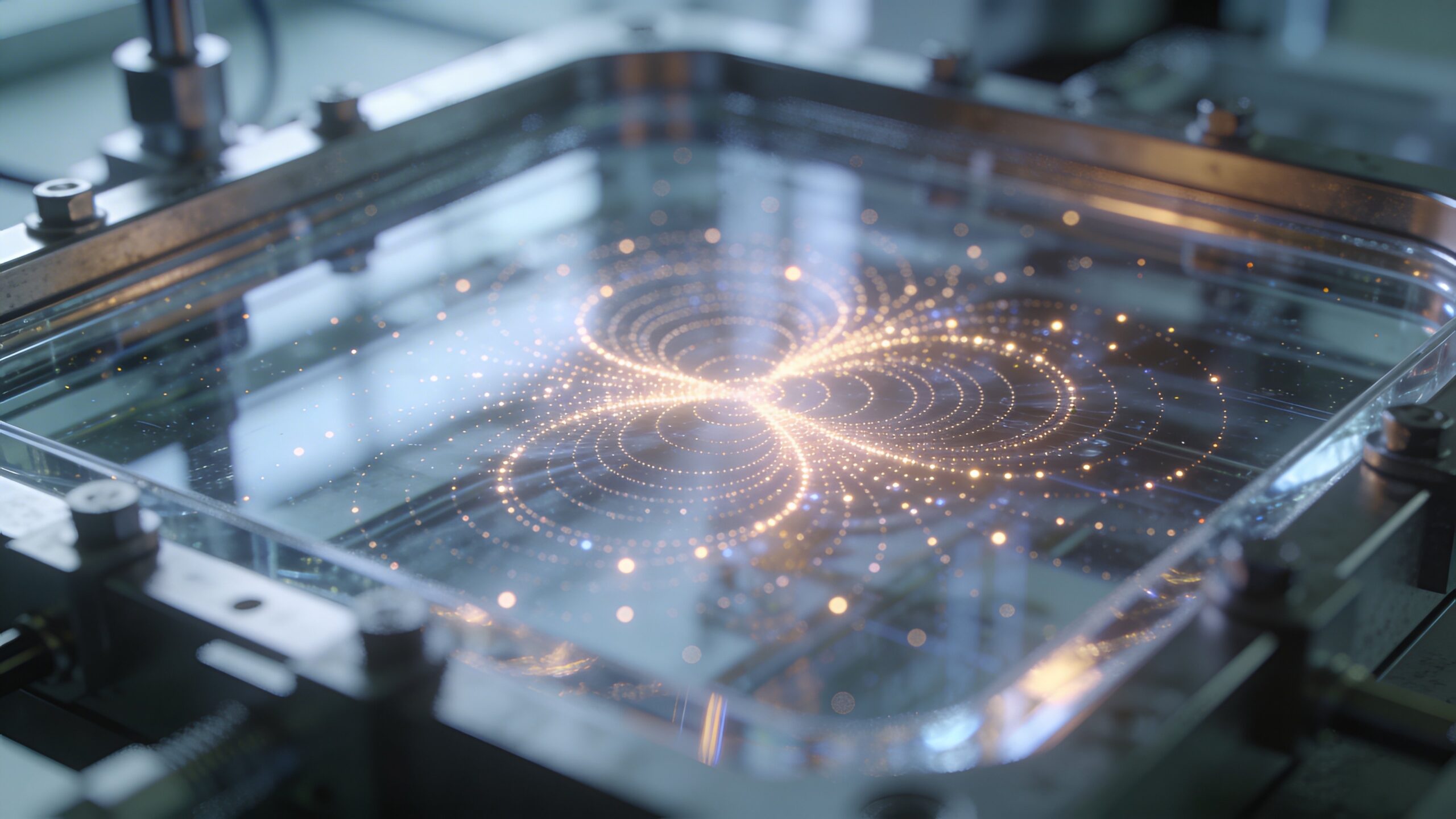
When people visualize the wavefunction, they often imagine a cloud rather than a solid object. An electron in an atom is not orbiting like a tiny planet. Instead, it exists as a fuzzy probability cloud surrounding the nucleus. The denser regions of the cloud represent higher chances of finding the electron there if a measurement is made.
The wavefunction evolves smoothly over time according to precise equations. Yet the moment a measurement occurs, the outcome becomes a single, definite result. This sudden jump from possibility to actuality is one of the most puzzling features of quantum physics and sits at the center of its probabilistic nature.
Measurement: When Possibility Becomes Reality
In quantum physics, measurement plays a special role. Before a measurement, a system exists in a range of possible states. After a measurement, it is found in one specific state. The probabilities encoded in the wavefunction determine how likely each outcome is, but not which one will occur.
This leads to an unsettling conclusion: quantum systems do not have definite properties until they are measured. Asking where an electron is before measurement is like asking which side of a coin is facing up before it lands. The question simply does not have a definite answer.
This does not mean that reality depends on human observers. Measurement can involve any interaction that forces a system to produce a definite outcome, such as a particle hitting a detector or exchanging energy with its environment. What matters is that quantum systems cannot remain indefinitely in a state of pure possibility when they interact with the world.
The Uncertainty Principle: Limits Written into Nature
One of the most famous expressions of quantum probability is the uncertainty principle, formulated by Werner Heisenberg. It states that certain pairs of properties, such as position and momentum, cannot both be known with perfect precision at the same time.
This is not a technological limitation. No improvement in instruments can overcome it. The more precisely you measure a particle’s position, the less precisely you can know its momentum, and vice versa. This trade-off is not a flaw in measurement but a reflection of how quantum systems are structured. The uncertainty principle reinforces the idea that probability is fundamental. Even with perfect preparation and ideal conditions, nature refuses to reveal all details simultaneously. Reality itself has built-in blur.
Why Electrons Do Not Follow Paths
In classical physics, objects move along well-defined trajectories. A ball thrown through the air follows a predictable path. In quantum physics, particles do not travel along single, definite routes.
The famous double-slit experiment illustrates this vividly. When electrons are fired one at a time toward a barrier with two slits, they create an interference pattern typically associated with waves. Each electron seems to pass through both slits at once, interfering with itself. Yet when detected, each electron arrives at a single point.
The pattern only emerges when many electrons are measured. The distribution of impacts matches the probabilities predicted by the wavefunction. Individual events remain unpredictable, but the overall statistical pattern is remarkably precise. This experiment highlights a key feature of quantum probability: certainty exists at the level of statistics, not individual events.
Randomness That Cannot Be Explained Away
Many scientists initially hoped that quantum randomness was only apparent, hiding deeper deterministic rules beneath the surface. Albert Einstein famously objected, saying that “God does not play dice with the universe.”
Decades of experiments have tested this idea. Results consistently show that no hidden variables can restore classical certainty without violating other fundamental principles, such as the independence of distant events. The universe appears genuinely random at its core.
This randomness is not chaotic or lawless. Probabilities follow strict mathematical rules. Quantum theory does not predict anything and everything; it predicts precise likelihoods that experiments confirm again and again.
Superposition: Many States at Once
Another reason certainty fails in quantum physics is superposition. A quantum system can exist in multiple states simultaneously until measured. An electron can be in several energy levels at once. A photon can take multiple paths simultaneously.
Superposition does not mean that the system switches rapidly between states. It means that the system truly occupies all allowed possibilities at the same time. The wavefunction encodes these overlapping possibilities and their relative probabilities.
This strange idea becomes easier to grasp when you think in terms of information rather than objects. Quantum systems carry information about many potential outcomes, not a single fixed state. Measurement forces that information to collapse into one result.
Entanglement: Probability Across Distance
Quantum probability becomes even stranger when systems interact and become entangled. Entangled particles share a joint wavefunction, meaning their probabilities are linked no matter how far apart they are.
If two particles are entangled and then separated by vast distances, measuring one instantly affects the probabilities of outcomes for the other. This does not involve signals traveling faster than light, but it does reveal that quantum probability is not confined to individual objects.
Entanglement shows that uncertainty can be shared across space. The universe does not assign probabilities to particles in isolation but to entire systems at once. Reality at the quantum level is deeply interconnected.
Why Quantum Probability Is So Reliable
Despite its uncertainty, quantum physics is one of the most accurate theories ever developed. It underlies technologies such as semiconductors, lasers, medical imaging, and quantum computing. The probabilities it predicts match experimental results with astonishing precision.
This reliability comes from the mathematical structure of the theory. While individual outcomes are unpredictable, the statistical patterns are exact. Over many measurements, quantum probabilities produce stable, repeatable results. This balance between uncertainty and precision is one of quantum physics’ most remarkable features. The universe is unpredictable in detail, yet astonishingly consistent in aggregate.
Living with a Probabilistic Universe
Quantum probability challenges our intuitions about reality. It forces us to abandon the idea that the universe always has definite answers waiting to be discovered. Instead, nature offers possibilities that become real only when events occur.
This shift has philosophical implications as well. It suggests that the future is not fully determined, even in principle. Probability is not just a tool for prediction but a fundamental aspect of existence. For non-scientists, the lesson is not that the universe is unknowable, but that it operates by different rules than our everyday experience suggests. Certainty gives way to likelihood. Prediction gives way to probability.
Why Nothing Is Certain—and Why That Matters
Quantum physics teaches us that uncertainty is not a flaw in our understanding but a feature of reality. The smallest building blocks of the universe do not behave like tiny machines following fixed scripts. They behave like participants in a grand probability game governed by strict but surprising rules. Nothing is certain at the quantum level, yet everything is meaningful. Probabilities are not random guesses; they are precise statements about what nature allows. By embracing this uncertainty, science has unlocked technologies, insights, and philosophical perspectives that reshape how we see the universe. In the end, quantum probability does not weaken our understanding of reality. It deepens it. It reminds us that the universe is not obligated to conform to human intuition, and that even in uncertainty, there is profound order waiting to be discovered.