For centuries, light has played tricks on the human mind. It illuminates our world, carries information across space, and makes life possible—yet when scientists try to pin down what light actually is, it refuses to behave. Sometimes light spreads out smoothly like ripples on a pond. Other times it crashes into matter like a stream of tiny bullets. This strange dual personality has puzzled thinkers from the earliest philosophers to modern quantum physicists, and it continues to challenge our everyday intuition. So what’s really going on? Is light a wave, a particle, or something else entirely? The answer is not just a compromise between two ideas—it’s a radical shift in how we understand reality itself.
A: It behaves as both depending on measurement.
A: A single packet of light energy.
A: Measurement affects quantum systems.
A: No—it follows quantum rules.
A: Yes, through probability waves.
A: No, it has no physical shape.
A: Energy depends on frequency, not brightness.
A: Yes—lasers, screens, and solar power depend on it.
A: Very much so.
A: No—it’s proven by experiments.
The Early Debate: Waves or Particles?
The story begins long before lasers and quantum mechanics. In the 1600s, two competing views of light emerged. Isaac Newton, one of history’s greatest scientists, argued that light was made of particles, which he called corpuscles. His theory explained why light travels in straight lines and reflects off mirrors like bouncing balls. Given Newton’s enormous influence, the particle view dominated science for decades.
At the same time, Christiaan Huygens proposed something very different. He suggested that light behaved like a wave, spreading through space much like sound spreads through air. His model could explain phenomena such as refraction, where light bends as it passes through glass or water.
For a long time, scientists lacked the experimental tools to settle the debate. Both models explained some observations well, and neither could explain everything. Light, it seemed, was already hinting that it refused to be simple.
The Triumph of the Wave Theory
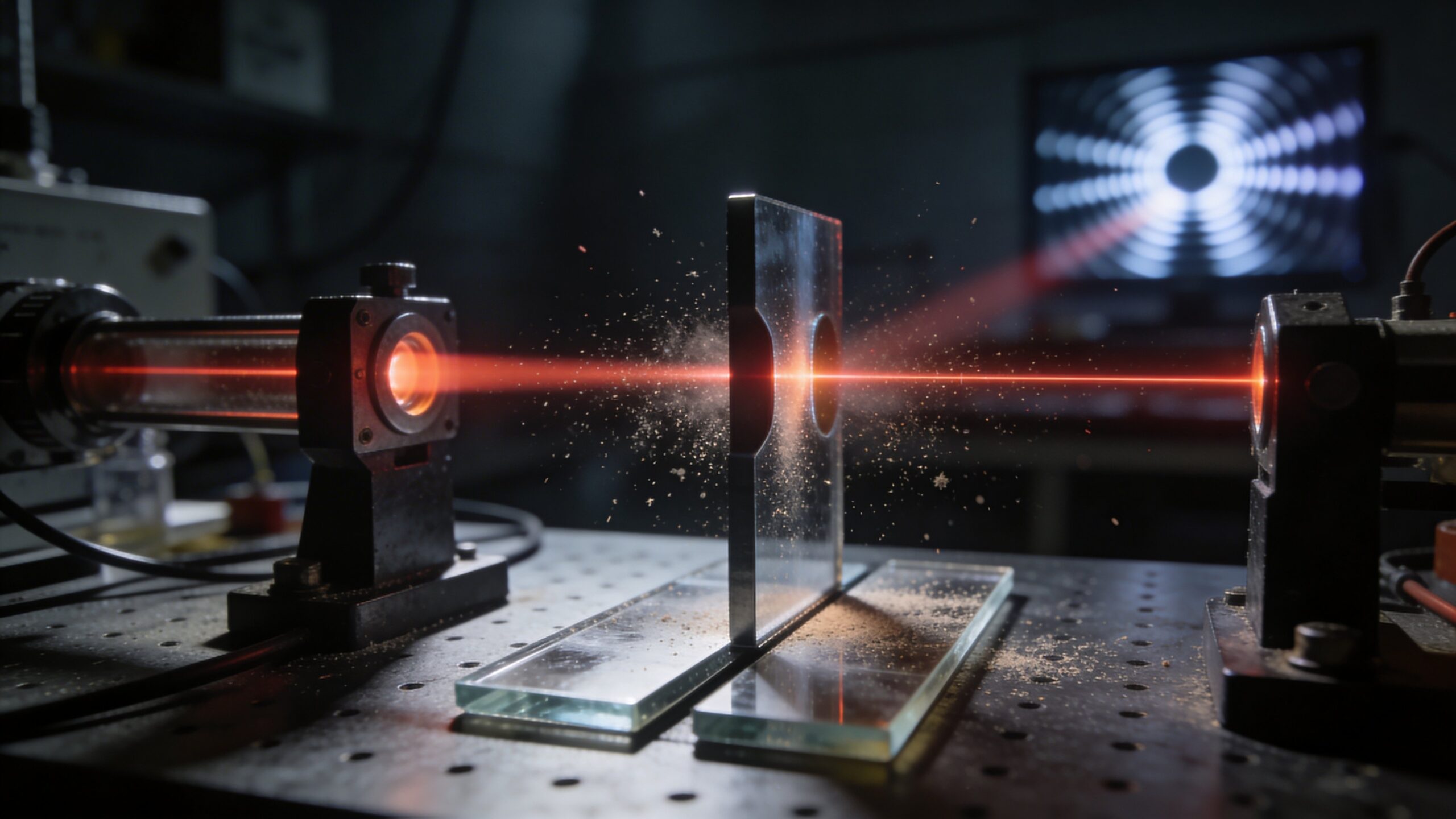
In the early 19th century, the wave model gained strong experimental support. The most famous demonstration came from Thomas Young and his double-slit experiment. When light passed through two narrow slits, it produced an interference pattern on a screen—alternating bright and dark bands that could only be explained if light waves were overlapping, reinforcing and canceling each other.
This behavior was impossible to reconcile with a simple particle picture. Particles fired through two slits should form two bright bands, not a striped interference pattern. The conclusion seemed clear: light was a wave.
Later in the century, James Clerk Maxwell unified electricity and magnetism into a single theory and showed that light itself is an electromagnetic wave. With Maxwell’s equations, the wave theory of light became one of the great triumphs of classical physics. For a moment, the mystery seemed solved.
Cracks in the Wave Picture
At the dawn of the 20th century, unexpected experimental results began to challenge the wave-only view. One of the most troubling puzzles was the photoelectric effect. When light shines on certain metals, it can knock electrons free—but only if the light has a high enough frequency. Brighter light doesn’t help if the frequency is too low.
According to classical wave theory, increasing brightness should increase the energy delivered, eventually ejecting electrons. But experiments stubbornly refused to cooperate. The effect depended on frequency, not intensity.
In 1905, a young Albert Einstein proposed a bold solution. He suggested that light comes in discrete packets of energy, later called photons. Each photon carries an energy proportional to its frequency. If the photon doesn’t have enough energy, no electron is ejected—no matter how many photons arrive.
This idea was shocking. Light, long understood as a wave, suddenly behaved like a particle again. Einstein’s explanation worked perfectly, earning him the Nobel Prize and reopening a debate many thought was settled.
Enter the Photon: Light as a Particle
The photon concept transformed physics. In this view, light interacts with matter in discrete events: one photon hits one electron, transferring a fixed amount of energy. This particle-like behavior explains not only the photoelectric effect, but also phenomena such as Compton scattering, where X-rays bounce off electrons like tiny billiard balls.
Yet photons don’t behave like classical particles either. They have no rest mass, always travel at the speed of light, and cannot be localized in the same way as everyday objects. Even when we call light a “particle,” it doesn’t fully fit the familiar definition.
This growing tension—light acting as both wave and particle depending on the experiment—led physicists toward a deeper and more unsettling conclusion.
Wave–Particle Duality: Not Either-Or
The breakthrough idea was wave–particle duality. Light is not sometimes a wave and sometimes a particle in the ordinary sense. Instead, it has properties of both, and which aspect appears depends on how we observe it.
In experiments that measure interference and diffraction, light behaves like a wave. In experiments that track energy transfer and collisions, it behaves like particles. Crucially, no experiment ever shows light behaving as both at once in a classical way.
This duality isn’t just a trick of measurement—it’s a fundamental feature of nature. Even more surprising, it doesn’t apply only to light. Electrons, atoms, and even large molecules also display wave-like behavior under the right conditions.
The Quantum Explanation: Probability Waves
Quantum mechanics offers a framework that goes beyond the wave-versus-particle argument. In this view, light is described by a quantum wavefunction. This wavefunction does not represent a physical ripple in space like a water wave. Instead, it encodes probabilities.
When light travels freely, its wavefunction spreads out, interfering with itself and producing wave-like patterns. When light interacts with a detector, the wavefunction collapses, and a single photon is detected at a specific location.
This is why a double-slit experiment with extremely faint light still produces an interference pattern over time. Photons arrive one at a time, each detected as a particle-like event, but the overall pattern reveals an underlying wave structure guiding their probabilities.
Observation and Measurement: Why Watching Matters
One of the most mind-bending aspects of light’s dual nature is the role of measurement. If an experiment is set up to determine which slit a photon passes through, the interference pattern disappears. The wave-like behavior vanishes, replaced by particle-like results.
This doesn’t mean human consciousness magically changes reality, but it does mean that the act of measurement—interaction with a measuring device—changes what can be observed. Quantum systems cannot reveal all their properties at once.
Light, in this sense, is not hiding a definite wave or particle identity. Its behavior is fundamentally tied to how it interacts with the world.
Light in Modern Technology
The wave–particle duality of light is not just a philosophical puzzle; it’s the backbone of modern technology. Lasers rely on the quantum behavior of photons to produce coherent light. Solar panels exploit the photoelectric effect to convert light into electricity. Fiber-optic communication uses light’s wave nature to transmit vast amounts of data with minimal loss.
Medical imaging, barcode scanners, quantum cryptography, and even smartphone cameras all depend on understanding light as both a wave and a particle. The strange theory works—and it works spectacularly well.
Is Light Really a Wave or a Particle?
At this point, the question itself may be misleading. Light is not a wave in the classical sense, nor is it a particle like a grain of sand. It is a quantum object that defies everyday categories.
Waves and particles are models—tools our minds use to understand observations. Light transcends those models. In quantum theory, it is an excitation of an electromagnetic field, described mathematically by probabilities rather than certainties.
When we ask what light “really is,” the most honest answer is that it is something fundamentally quantum, and our classical language struggles to capture it.
Why This Matters Beyond Physics
The lesson of light’s dual nature reaches beyond laboratories and equations. It shows that nature is not obligated to conform to human intuition. Reality can be stranger, richer, and more subtle than the concepts we inherit from everyday experience.
Light teaches us humility. It reminds us that knowledge evolves, that contradictions can point to deeper truths, and that the universe often demands new ways of thinking.
The Ongoing Mystery
Even today, physicists continue to explore deeper questions about light. How does quantum information travel? Can photons be entangled across vast distances? What does light reveal about the structure of space and time itself? Each answer uncovers new mysteries. Light, the very thing that allows us to see, remains one of the most profound puzzles in science.
Conclusion: Living with the Paradox
Light is both wave and particle—and neither in the way we imagine. It spreads, interferes, collides, and quantizes, all according to the strange but precise rules of quantum mechanics. What’s really going on is not a contradiction, but a deeper reality that resists simple labels. By embracing this paradox, science has unlocked technologies, reshaped philosophy, and expanded our understanding of the universe. Light doesn’t just illuminate the world around us; it illuminates the limits of human intuition and the extraordinary nature of reality itself.