A Small Spark That Changed the Rules
The photoelectric effect began as a strange little observation about light and metal. Shine light on certain clean metal surfaces, and electrons can leap away from the surface. At first glance, that sounds like a routine electrical trick. To physicists near the end of the nineteenth century, though, it became a quiet crisis. The effect behaved as if light did not always arrive as a smooth, spread-out wave. It behaved as if light delivered energy in countable packets.
A: Color corresponds to frequency, and frequency sets the energy carried by each photon.
A: Yes. Above the threshold, brighter light usually means more photons and therefore more emitted electrons.
A: Each photon lacked enough energy to overcome the metal's work function.
A: No. He showed that wave theory was incomplete for certain energy exchanges.
A: It is the minimum energy needed to remove an electron from a particular material.
A: A successful electron receives enough energy from a single photon rather than slowly storing wave energy.
A: He verified the linear relationship between light frequency and electron energy.
A: Einstein's Nobel Prize cited his photoelectric explanation, highlighting its importance to quantum theory.
A: No. Related physics underlies light sensors, solar cells, and material-analysis tools.
A: Microscopic energy exchange is quantized, and classical intuition alone is not enough.
Why This Puzzle Could Not Stay Small
That detail mattered because classical physics had been remarkably successful. Maxwell’s electromagnetic theory described light as a wave, and wave thinking explained reflection, refraction, interference, and diffraction beautifully. Yet the photoelectric effect refused to fit the expected script. Brighter light did not automatically free more energetic electrons. Dim light of the right color could trigger emission almost instantly, while intense light of the wrong color could do nothing. The laboratory result was simple; the implication was enormous.
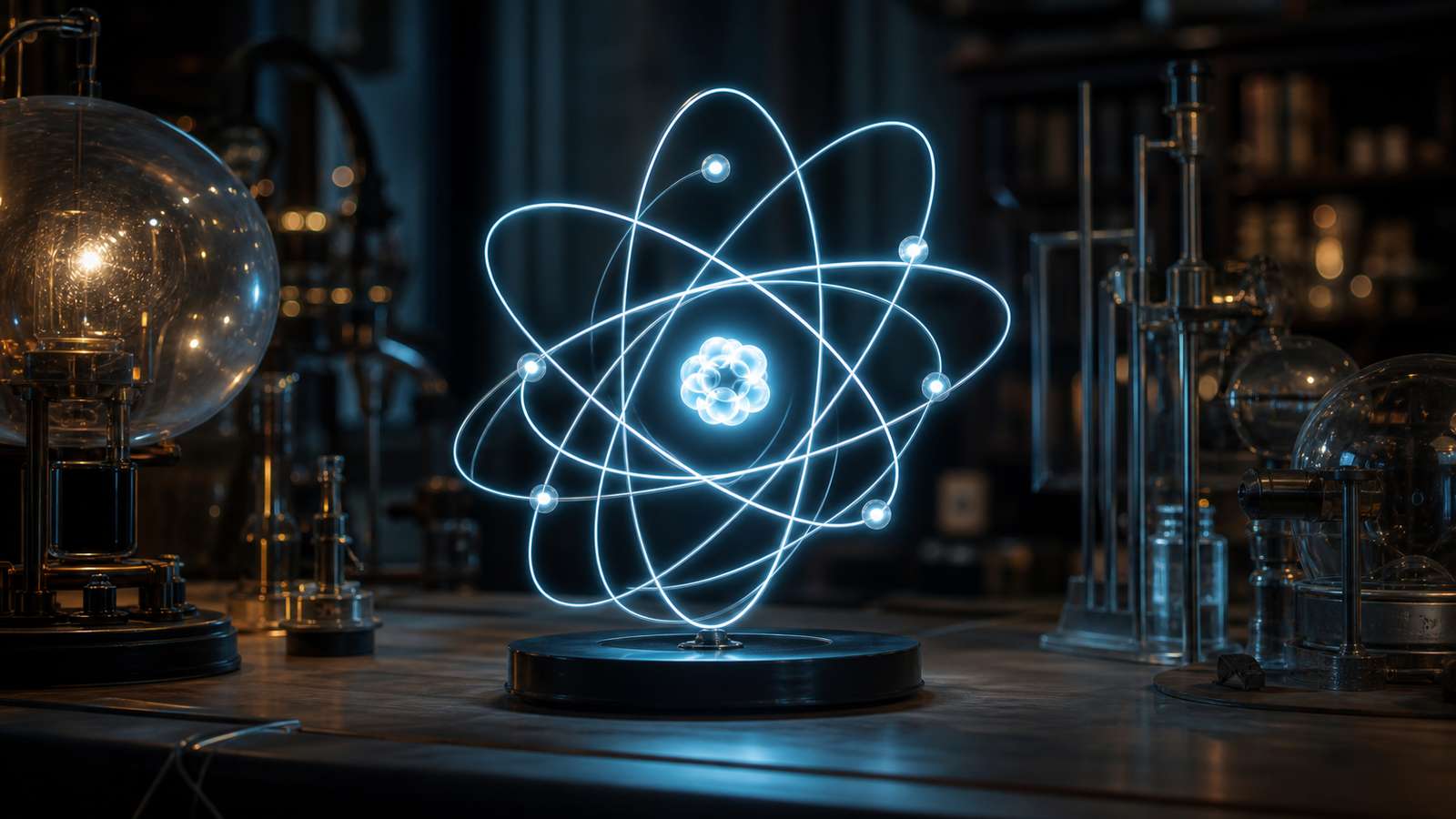
When Albert Einstein explained the effect in 1905, he treated light as if its energy came in discrete quanta, later called photons. That move helped turn Planck’s earlier quantum idea from a mathematical workaround into a physical claim about nature. The photoelectric effect did not create quantum mechanics by itself, but it gave the revolution one of its clearest starting points: energy at microscopic scales is not always continuous, and the old categories of wave and particle cannot survive unchanged.
The Classical Prediction That Failed
Classical wave theory pictured light as an electromagnetic wave whose energy was spread across the wavefront. Under that view, a brighter beam should deliver more energy to the metal surface because a stronger wave carries more intensity. If electrons needed energy to escape the metal, it seemed natural to expect that increasing brightness would eventually knock them out. The color of the light, or its frequency, should have mattered less than the total energy being poured onto the surface.
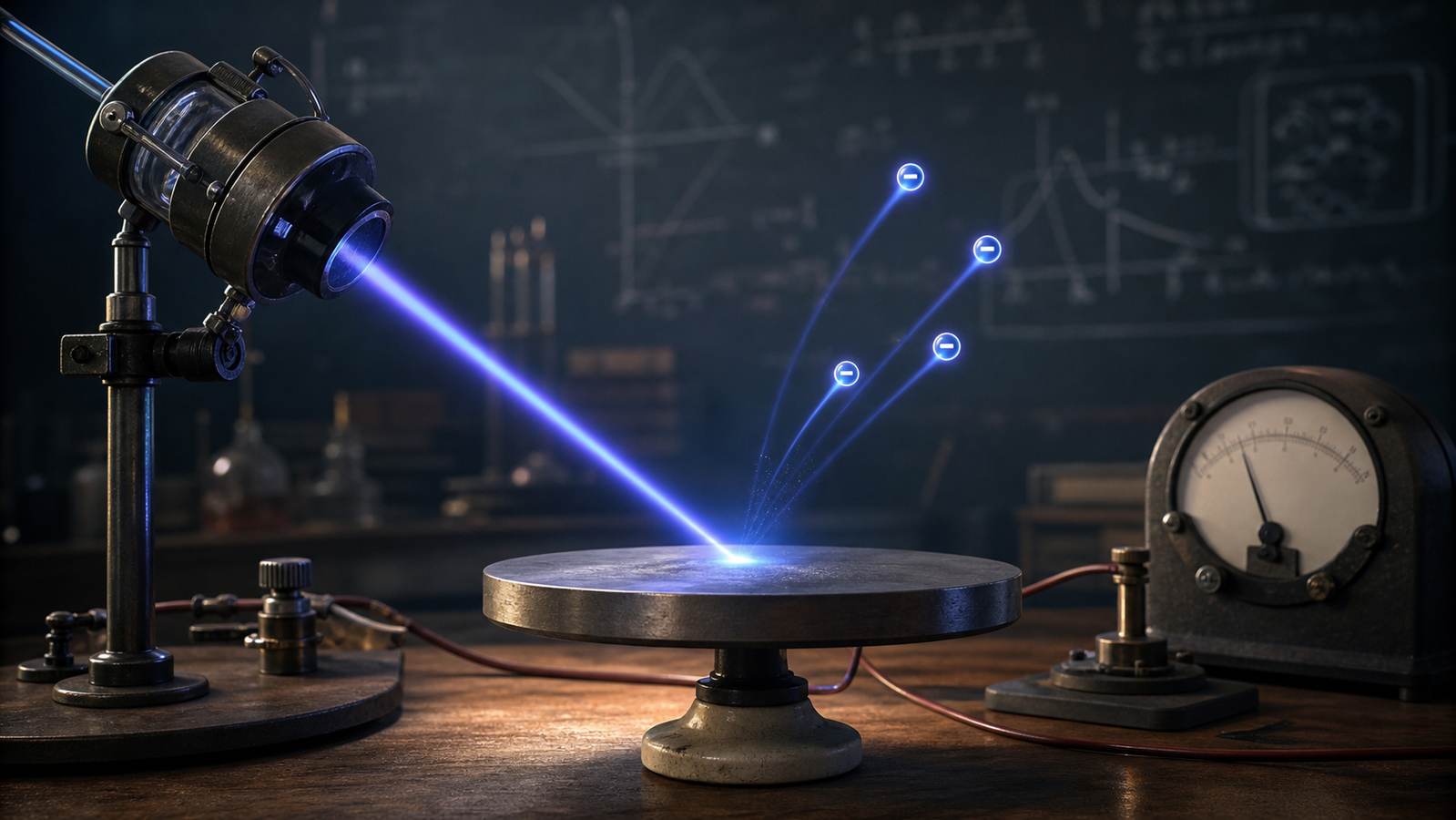
Experiments told a different story. Below a certain threshold frequency, no electrons were emitted at all, even if the light was made very bright. Above that threshold, electrons appeared quickly, even when the light was faint. Increasing brightness above the threshold increased the number of emitted electrons, but it did not increase their maximum kinetic energy. Raising the frequency did. This pattern was deeply awkward for a purely wave-based explanation.
The threshold was especially revealing. Each metal held its electrons with a characteristic binding energy, often called the work function. If incoming light had too little energy per quantum, an electron could not escape. Piling up more low-frequency light did not help, because each interaction still failed to deliver enough energy in a single exchange. Nature was acting less like a continuous reservoir and more like a turnstile that opened only when each arriving packet carried the right amount.
That made the experiment unusually good at separating two ideas that can look similar in everyday life. In ordinary lighting, brightness and color can both change what we see, so it is tempting to treat them as cosmetic features of the same beam. In the photoelectric effect, they play different physical roles. Brightness changes the rate at which energy packets arrive. Color changes the energy carried by each packet. Once those roles are separated, the old wave picture loses its grip on the result.
Einstein’s Quantum Leap
Einstein’s 1905 explanation was daring because it took a mathematical idea seriously as a physical description. Max Planck had introduced energy quanta in 1900 while studying blackbody radiation, but many physicists treated the move cautiously. Einstein argued that light itself could be considered as localized energy packets, with each packet’s energy proportional to its frequency. In modern notation, that relationship is written as E = hf, where h is Planck’s constant and f is frequency.
In the photoelectric effect, one photon gives its energy to one electron. Part of that energy pays the work function, freeing the electron from the metal. Any leftover becomes the electron’s kinetic energy. That simple accounting explained the threshold frequency, the immediate emission, the link between frequency and electron energy, and the link between brightness and electron count. Brighter light meant more photons, so more electrons could be released. Higher-frequency light meant more energy per photon, so each successful electron could leave faster.
This was not merely a clever fit to data. It changed what physicists could mean by light. Light still showed wave behavior in interference experiments, yet here it demanded a particle-like energy exchange. Einstein’s model did not erase waves; it made the classical wave picture incomplete. The photoelectric effect became one of the earliest and most persuasive signs that microscopic reality would require a new language.
The explanation also gave students and experimenters a rare gift: a quantum idea that could be drawn as a clear energy budget. One incoming photon has one amount of energy. The material charges an escape cost. The outgoing electron carries whatever remains. Of course, real surfaces and real instruments add complications, but the central logic stays remarkably direct. That directness is why the effect still appears early in physics courses. It lets the quantum revolution enter through evidence rather than through abstraction first.
Why the Effect Was So Convincing
The strength of the photoelectric effect as evidence comes from how sharply it separated competing expectations. A vague anomaly can often be patched. This one produced clean measurable relationships. The maximum electron energy rose linearly with light frequency. The threshold frequency depended on the metal. The stopping voltage needed to halt emitted electrons gave experimenters a practical way to measure their kinetic energy. The results were not philosophical; they were instrument readings.
Robert Millikan, who was initially skeptical of Einstein’s light quantum idea, performed careful photoelectric measurements and confirmed Einstein’s equation with impressive precision. Millikan did not immediately embrace every implication, but the data became hard to ignore. The same constant Planck had used for heat radiation appeared in the behavior of light freeing electrons from metal. Separate puzzles were beginning to point toward the same hidden rule.
This matters historically because acceptance of quantum ideas was not instant. Many physicists were cautious, and for good reason. Classical theories had earned trust by explaining a vast range of phenomena. A new idea had to do more than sound interesting; it had to survive measurement, predict numbers, and connect puzzles that had seemed unrelated. The photoelectric effect helped quantum theory meet that standard. It showed that the strange constant in Planck’s radiation law was not confined to one special problem.
That convergence is why the effect became a landmark. It tied together blackbody radiation, atomic-scale energy exchange, and the emerging idea that energy transfer has a grainy structure. In 1921, Einstein received the Nobel Prize in Physics specifically for his explanation of the photoelectric effect, not for relativity. The award reflected how central this explanation had become to the new physics.
From Metal Surfaces to Quantum Mechanics
The photoelectric effect helped prepare the ground for quantum mechanics because it made discreteness unavoidable. Once physicists accepted that light could exchange energy in packets, other microscopic systems looked different too. Atoms emitted and absorbed light at specific frequencies. Electrons occupied stable states instead of spiraling into nuclei. Spectral lines, heat radiation, and chemical behavior all began to look like clues from a world governed by allowed transitions rather than smooth classical motion.
The effect also sharpened the wave-particle problem. Light could diffract like a wave and strike like a packet. Later quantum theory would avoid forcing light into only one classical category. Instead, it would describe quantum objects with mathematical states whose measurement outcomes can appear particle-like or wave-like depending on the experiment. The photoelectric effect did not provide that full theory, but it exposed the need for it in a form students can still test and understand.
In that sense, the effect stands at the border between old and new physics. It is simple enough to describe without advanced mathematics, yet strong enough to point beyond common intuition. It asks a direct question: if light is only a continuous wave, why should a faint blue beam succeed where an intense red beam fails? The quantum answer is not that the blue beam is magically stronger overall. It is that each blue photon carries a larger indivisible unit of energy.
Its legacy extends beyond theory. Photodiodes, solar cells, image sensors, night-vision devices, and many light-detection technologies depend on related principles. Whenever light is converted into an electrical signal, the quantum idea behind the photoelectric effect is close by. A problem that once unsettled the foundations of physics now sits inside everyday technology.
Common Misunderstandings About the Breakthrough
One common misunderstanding is that the photoelectric effect proved light is simply a particle and not a wave. The deeper lesson is subtler. Light cannot be fully described by the old classical wave model, but it also cannot be reduced to tiny classical pellets flying through space. Quantum physics keeps the successful wave predictions while changing how energy, probability, and measurement are understood.
Another misunderstanding is that brightness has no role. Brightness matters, but it affects how many photons arrive, not how much energy each individual photon carries. If the frequency is above the threshold, brighter light can release more electrons per second. If the frequency is below threshold, extra brightness still cannot supply enough energy per photon to free electrons in the simple photoelectric process.
A third confusion is treating the threshold as a universal number. It depends on the material. Different metals hold electrons with different work functions, so the minimum light frequency changes from surface to surface. This material dependence made the effect especially useful, because it linked a visible experimental outcome to the internal energy structure of matter.
It is also worth distinguishing the photoelectric effect from every situation where light warms a material. Heat can build up gradually in many ordinary settings, and intense light can certainly change a surface by heating it. The classic photoelectric effect is about electron emission caused by quantum energy transfer. That is why the threshold and stopping-voltage measurements are so important: they show a specific microscopic mechanism rather than a general warming effect.
Why This Moment Still Matters
The photoelectric effect matters because it shows how revolutions in science often begin. The experiment was not grand in appearance. It involved light, metal, current, and careful measurement. Yet it revealed that a trusted framework could not explain everything it was supposed to explain. Rather than ignoring the mismatch, physicists followed it into unfamiliar territory.
That is the enduring lesson. Quantum mechanics did not arrive because scientists wanted mystery. It arrived because ordinary experiments, repeated precisely, forced a new account of nature. The photoelectric effect gave that shift a crisp and teachable form: color can matter more than brightness, energy can arrive in packets, and the microscopic world follows rules that are exact but not classical.
For anyone beginning quantum mechanics, the photoelectric effect is one of the best doorways. It connects history, experiment, mathematics, and technology without requiring the full machinery of wave functions. A beam of light strikes a metal plate, electrons escape, and the modern picture of reality begins to open.