Duality Is a Clue, Not a Contradiction
Wave-particle duality is the fact that quantum objects can produce interference patterns like waves and discrete detections like particles. The phrase can sound as if electrons or photons switch costumes, but the deeper lesson is subtler.
A quantum system is not a tiny classical ball and not an ordinary water wave. It is described by a quantum state whose behavior depends on how the experiment is arranged.
Different interpretations explain this same pattern in different ways. Copenhagen emphasizes complementarity: wave-like and particle-like descriptions belong to different experimental contexts. Many-Worlds treats the wavefunction as real and says all components evolve until records separate into branches.
Bohmian mechanics gives particles definite positions guided by a wave, so duality is built into the combination.
Objective-collapse theories allow wave-like evolution until a physical collapse selects an outcome. Relational and information-based views focus on what can be said relative to an interaction or agent. The experiments are the same, but the story changes.
Duality is therefore a perfect test case for interpretation because it asks what the wavefunction, the detection event, and the measurement context really mean.
A: It is quantum, and wave or particle language applies in limited contexts.
A: The probability pattern reflects coherent alternatives in the quantum state.
A: Interference is lost because the alternatives become physically distinguishable.
A: It uses complementarity between experimental arrangements.
A: The wavefunction evolves into branches with definite records.
A: It adds definite particles guided by a wavefunction.
A: Yes, but they add a real transition to one outcome.
A: No ordinary classical picture captures it fully.
A: The crucial change is physical record formation.
A: Quantum categories are broader than wave or particle alone.
The Basic Pattern
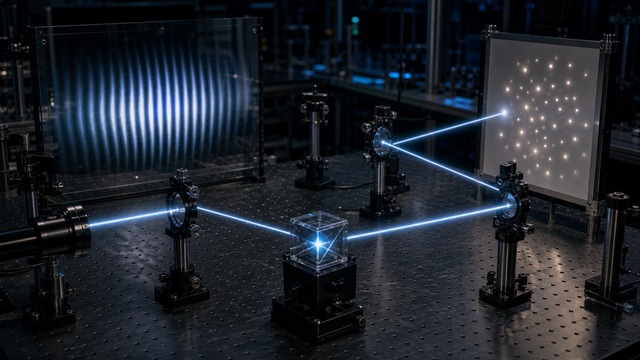
In a double-slit experiment, a quantum system can build up an interference pattern one detection at a time. Each detection is localized, like a particle hitting a screen. Yet the overall distribution reflects wave-like interference between alternatives.
If which-path information is gathered, the interference disappears. The setup determines which aspect can appear.
That pattern is not a defect in the experiment. It is one of the clearest windows into quantum theory. Classical objects do not behave this way. A marble goes through one slit and makes a pile.
A water wave passes through both and interferes. A quantum object gives localized hits whose statistics depend on wave-like alternatives.
Copenhagen and Complementarity
Copenhagen-style interpretations explain duality through complementarity. Wave and particle descriptions are both useful, but they cannot be combined into one ordinary classical picture. The experimental arrangement determines which description is meaningful. A setup that reveals interference does not also reveal a definite path in the same classical sense.
This approach is practical and disciplined. It does not ask the electron to be a little ball and a little wave at the same time. Instead, it says that classical concepts apply under specific experimental conditions. The wave description helps predict probabilities. The particle-like event appears as a localized record.
The cost is that Copenhagen does not always satisfy readers who want a picture of what the electron is doing between preparation and detection. It says the demand for a single classical picture is the wrong demand. That answer is powerful, but not everyone finds it complete.
Many-Worlds and the Full Wavefunction
Many-Worlds treats the wavefunction as physically real and never collapsing. In an interference experiment, the different path components of the wavefunction remain part of the total state and can interfere. When a detection occurs, the detector and environment become entangled with the result, and branches contain definite records.
In this view, the wave aspect is fundamental. The particle-like detection is a branch record, not evidence that a classical particle traveled secretly through one path all along. Duality arises because the universal wavefunction can spread, interfere, and later correlate with localized detector states.
This makes Many-Worlds elegant about wave evolution. It does not need a special collapse to erase alternatives. But it must accept that measurement creates branch structure. The everyday particle appearance is local to a branch, while the full state remains wave-like and expansive.
That branch-local language is important. A person inside one branch sees one spot on the detector, not a ghostly blur of all spots. The full explanation is wave-like, but each experienced record is definite.
Many-Worlds therefore does not deny particle-like data; it explains them as local records within a larger uncollapsed state.
Bohmian Mechanics and Pilot Waves
Bohmian mechanics offers perhaps the most literal wave-particle explanation. A particle has a definite position, while the wavefunction guides its motion. In a double-slit experiment, the particle goes through one slit, but the guiding wave passes through both and shapes the possible trajectory.
The final detection is particle-like because the particle is always somewhere.
The interference pattern appears because the guiding wave carries information about both paths. Even an empty branch of the wave can influence how the actual particle moves. This picture is vivid and realist, but it is not classical.
The guiding wave lives in a high-dimensional configuration space for many-particle systems and produces nonlocal effects in entangled cases.
This interpretation is especially helpful for seeing why duality is not simply a logical contradiction. There really is a particle and there really is a wave-like guiding structure, but neither behaves like its everyday namesake. The familiar words survive only after being placed inside a new kind of theory.
Objective Collapse and the End of Spreading
Objective-collapse theories allow wave-like spreading for small systems, then introduce a real physical collapse under certain conditions. A particle or photon can evolve according to the wavefunction, showing interference when alternatives remain coherent. When a collapse event occurs, one outcome becomes real and the other possibilities are suppressed.
This gives duality a before-and-after structure. Before collapse, wave-like behavior governs probabilities and interference. After collapse, a definite particle-like record exists. The challenge is to specify the collapse mechanism precisely enough to preserve known quantum success while making new predictions that can be tested.
For readers who dislike observer-dependent collapse, objective-collapse theories are appealing. They make the transition from wave-like possibility to definite event a feature of nature. The price is that the standard theory must be altered.
The strength of this account is psychological as well as physical. It gives a direct reason why macroscopic records are not indefinite. The weakness is that collapse must be written into nature carefully enough not to spoil interference where interference is observed.
Relational and Information-Based Explanations
Relational quantum mechanics treats properties as tied to interactions. A system may not have an absolute path property independent of a measuring relation, but it can have a definite outcome relative to a detector that interacts with it. Duality then reflects the fact that different interactions support different facts.
Information-centered views shift attention to the expectations an agent can assign. A wavefunction encodes probabilities for possible experiences or records, not necessarily a direct wave substance in space. The particle-like event is the experience or data update, while the wave-like calculation organizes expectations across possible arrangements.
Why Which-Path Information Matters
All interpretations must explain why interference disappears when which-path information becomes available. Copenhagen says the experimental context has changed; the path question and interference question are complementary. Many-Worlds says the path alternatives become entangled with records, preventing later interference between branches.
Bohmian mechanics says the guiding wave and effective configuration change when path detection is introduced.
Objective-collapse theories may say that the measurement-like interaction helps select an outcome. Relational views say a path fact becomes established relative to an interacting system. Information views say the probability assignment changes because the available information has changed.
The shared lesson is that path information is physical. It is not a harmless label added after the fact.
This is why duality is not merely about what humans know. A path marker can destroy interference even if nobody reads it immediately. The possibility of a stable record changes the quantum situation. Interpretations differ in how they describe that change, but they agree that the experimental arrangement matters.
That agreement is important. The interpretations may argue about ontology, but none can ignore the fragility of coherence. A tiny path trace in the environment can be enough to change what patterns remain possible. Wave-particle duality is therefore not a museum paradox. It is an active design principle in real experiments.
Why Duality Still Misleads
Duality misleads when it is treated as a personality split inside a tiny object. The quantum system is not confused about whether to be a wave or a particle. Our classical vocabulary is the part under stress.
The word “wave” points to interference and amplitudes, while the word “particle” points to localized exchanges and records. Neither word captures the whole theory alone.
It also misleads when people assume the system changes merely because a human looks. The decisive issue is whether the experiment preserves coherent alternatives or creates distinguishing records. That is a physical question about interactions, not a theatrical question about attention. Interpretations help by saying exactly what those records mean.
The Takeaway
Wave-particle duality does not mean quantum objects are confused. It means classical categories are too small. Quantum systems produce wave-like statistics and particle-like records depending on how they are prepared, allowed to evolve, and measured. The interpretations explain that pattern through different claims about the wavefunction and measurement.
Copenhagen emphasizes complementary contexts. Many-Worlds emphasizes a real, uncollapsed wavefunction. Bohmian mechanics combines definite particles with guiding waves. Objective collapse turns spreading possibilities into one outcome through new dynamics. Relational and information-based views focus on facts and expectations tied to interactions.