How the Copenhagen Interpretation Became the Standard View of Quantum Physics
The Copenhagen interpretation became standard because it offered working physicists a practical language for measurement, probability, and laboratory results.

Exploring the Secrets of the Quantum World
The Copenhagen interpretation became standard because it offered working physicists a practical language for measurement, probability, and laboratory results.
Quantum branching is often described as the universe splitting, but the careful idea is about decohered records inside a larger wavefunction.
Many-Worlds sounds wild, but its simplest idea is direct: the wavefunction never collapses, and measurement creates separate branches of records.
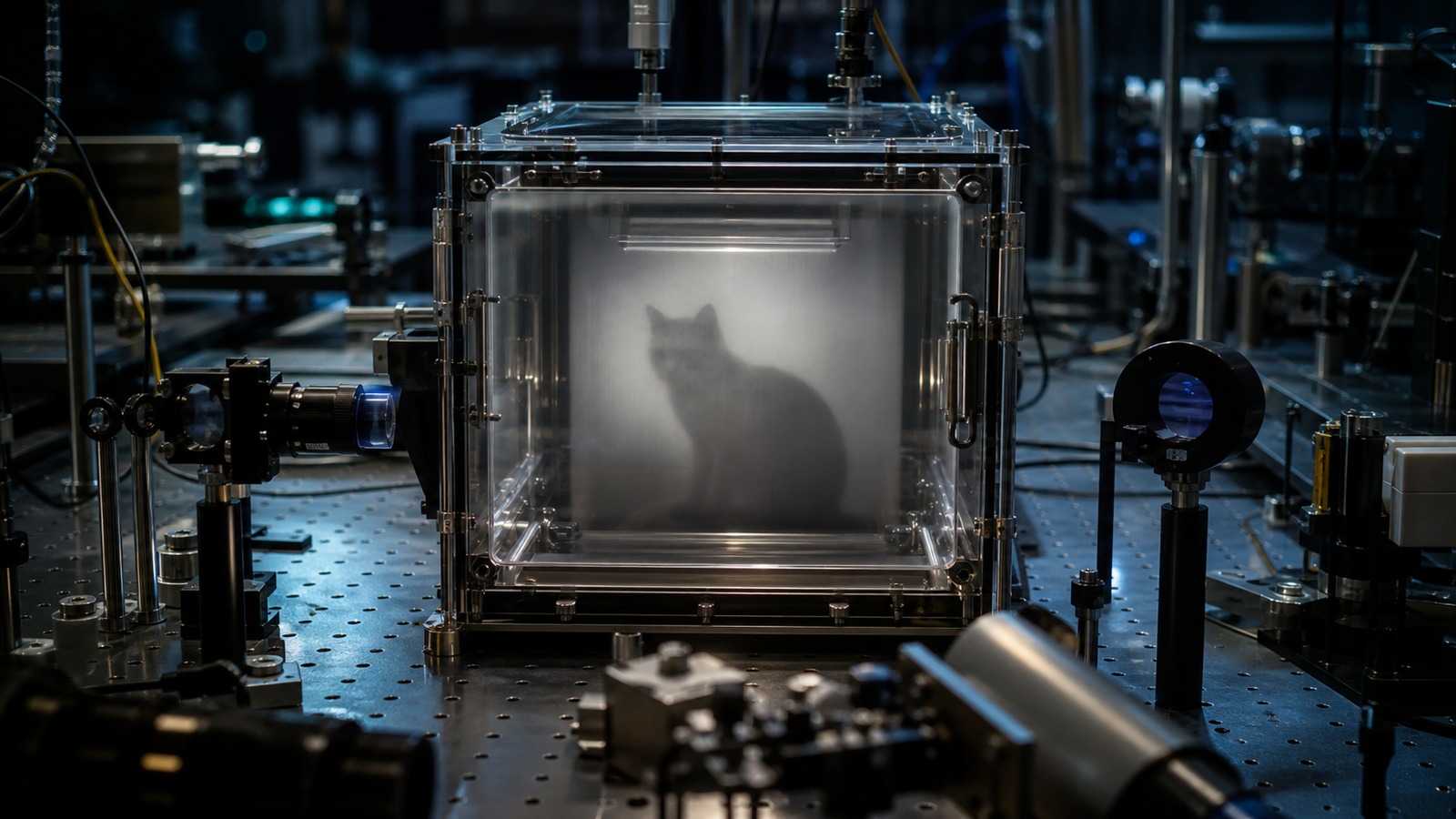
Schrodinger’s cat is not really about a cat. It is a sharp test of what different quantum interpretations say about measurement, collapse, and reality.
Scientists agree that quantum mechanics works, but they still debate what it says about reality because several interpretations share the same predictions.
Quantum philosophy asks what the mathematics of quantum mechanics says about reality, knowledge, probability, observation, and the limits of classical intuition.
Wavefunction collapse can mean a real physical event, an update in knowledge, or an apparent effect of branching and decoherence, depending on the interpretation.
The measurement problem asks why quantum possibilities turn into definite results. Different interpretations answer by changing what collapse, reality, or information means.
The Many-Worlds interpretation says the wavefunction never collapses. Instead, every possible outcome remains in a vast branching quantum reality.
The Copenhagen view does not say human attention magically creates the world. It says quantum properties become definite within measurement contexts that produce shareable physical records.
Quantum interpretations multiply because the math works while the meaning remains open. Different views agree on many predictions but disagree about what the wavefunction, measurement, and reality are telling us.
Many-Worlds is more than a parallel-universe slogan. It is a serious attempt to explain quantum measurement without wave-function collapse.